Alien Life
From 3I/ATLAS to the question of other civilisations
Theme of conversation
3I/ATLAS: The Invasion Is Postponed
So what, in the end, did we learn about 3I/ATLAS? Has the alien invasion been postponed?
ChatGPT ResponseClick to collapse or expand
Yes 😄 As of 8 August 2026, the alien invasion by way of 3I/ATLAS may safely be regarded as postponed indefinitely. The evidence accumulated over recent months increasingly points to something highly unusual, but entirely natural: an interstellar comet.

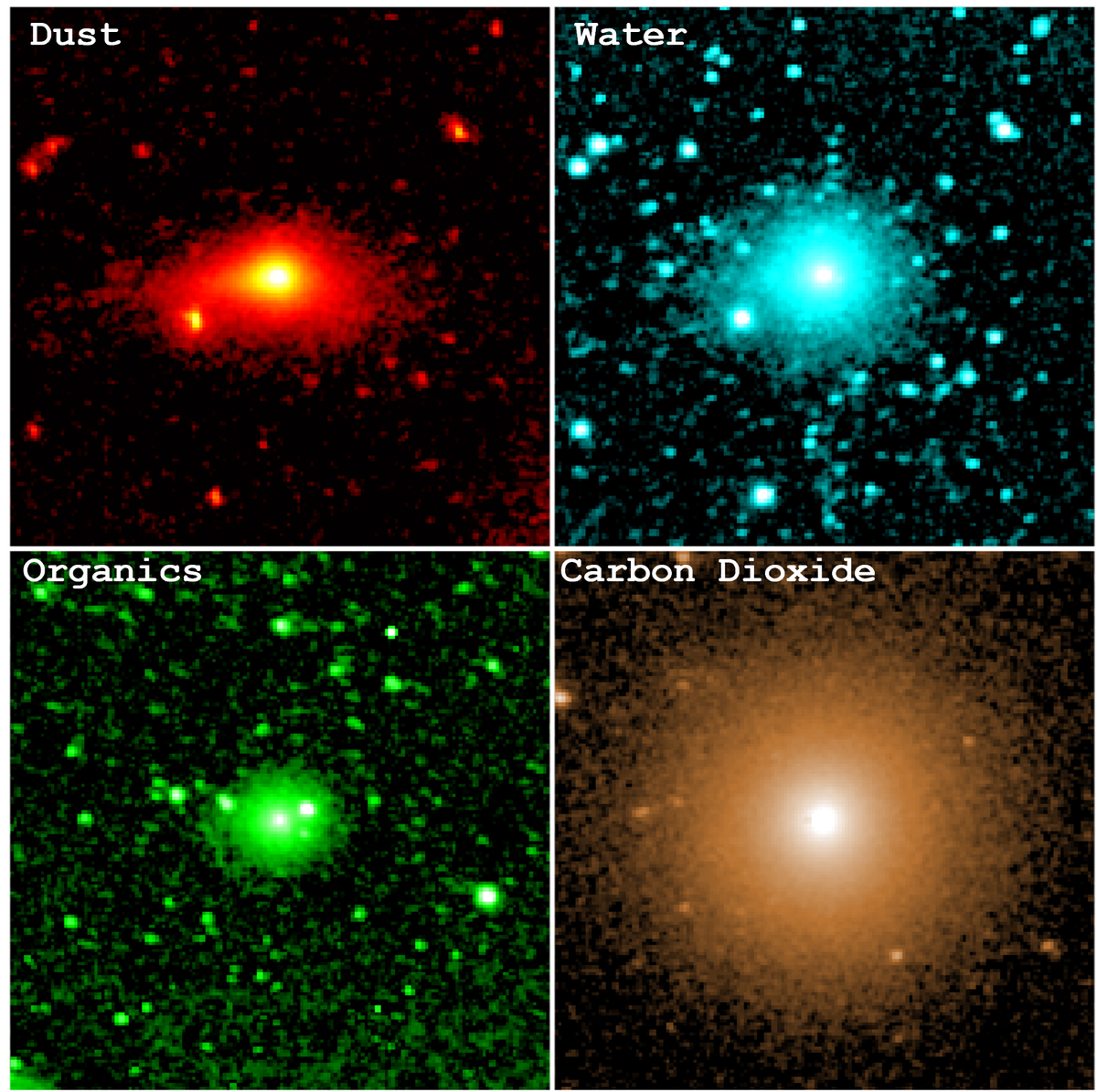

The most intriguing discovery may, in fact, be better than the story of an alien craft. 3I/ATLAS appears to be staggeringly old. JWST measurements of the isotopic composition of its water and carbon look nothing like those of comets born in our own Solar System. A study published in Nature this summer suggests that the object formed below roughly 30 K, in a metal-poor environment, and may have been expelled from its home system 10–12 billion years ago. We may therefore be looking at a surviving fragment of a planetary system from the Milky Way’s youth. (Nature)
Meanwhile, nearly all the much-advertised “anomalies” have acquired explanations that are decidedly more prosaic.
Its unusual chemistry. That part is real: an enormous abundance of CO₂ relative to water, along with CO, methane, OCS, nickel and more. But JWST is directly observing a gaseous coma and the products of sublimation. The exceptionally high CO₂/H₂O ratio fits rather well with an object formed in a profoundly different—and much colder—environment. (arXiv)
Its non-gravitational acceleration. This supplied one of the favourite “Aha—it’s manoeuvring!” arguments. Yet the measured acceleration is consistent with recoil from asymmetrical CO₂ and CO outgassing. Depending on the assumptions used, current estimates put the nucleus at around a kilometre across or less. No mysterious engine is needed to account for its path. (arXiv)
Its Sunward-pointing anti-tail. This really was unusual. Observations made by China’s Tianwen-1 spacecraft from orbit around Mars proved especially useful: the coma contains abundant dust grains hundreds of micrometres across, leaving the nucleus at roughly 3–10 m/s. Their motion under solar radiation pressure, combined with the geometry of observation, can reproduce the tail’s peculiar appearance rather well. (DOI)
Most amusingly, astronomers did take the “What if it is transmitting?” possibility seriously enough to test it.
Breakthrough Listen and SETI examined 3I/ATLAS with several radio telescopes. The Allen Telescope Array, MeerKAT and the Green Bank Telescope found nothing. The ATA search began with roughly 74 million candidate radio detections; filtering reduced that number to about 200, every one of which proved to be terrestrial interference or a satellite. (SETI Berkeley)
In July 2026, China’s FAST telescope added a dedicated search for periodic signals. Again, it found not a single convincing technosignature. Within the particular frequency range and signal class examined, the search was sensitive to an equivalent transmitter power of about 0.146 W. That does not prove the absence of every technology one might imagine, of course; it simply means that no positive evidence of artificial origin has emerged. (arXiv)
Its trajectory, too, has ceased to be a cause for alarm. 3I/ATLAS passed perihelion on 30 October 2025, came no closer to Earth than approximately 270 million kilometres (1.8 au), and is now leaving the Solar System, never to return. (NASA Science)
So the balance of evidence now looks roughly like this:
“Alien craft” — almost no evidence remains in its favour.
“Ordinary comet” — not quite that either.
“An immensely ancient interstellar comet with exotic chemistry” — now that is genuinely fascinating.
The irony is that the real discovery may be more interesting than the spacecraft hypothesis. If the estimate of 10–12 billion years survives further scrutiny, then we have quite literally observed matter from a planetary system that may have formed five to seven billion years before our own.
Avi Loeb, of course, has signed no declaration of surrender 😄 He continues to examine the exotic possibilities. But compared with the summer and autumn of 2025, the room left for ‘something technological’ has become much, much smaller.
Theme of conversation
Are We Alone?
Do you think extraterrestrial life exists?
ChatGPT ResponseClick to collapse or expand
I think so: extraterrestrial life almost certainly exists. But I would draw a hard line between three very different claims.
Simple life elsewhere in the Universe seems highly probable to me. Our galaxy alone contains hundreds of billions of stars. Planets have proved commonplace; water and organic molecules are widespread. It would be rather astonishing if the chemistry that gave rise to life on Earth had worked precisely once.
Intelligent, technological life also seems entirely possible, though my confidence is much lower. Between a bacterium and a civilisation capable of building radio telescopes lie some four billion years of highly particular evolutionary history. We simply do not yet know how rare that transition is.
Aliens have visited Earth, or are here now is a different claim altogether, and we have no compelling evidence for it. Neither UFOs and UAPs, nor 3I/ATLAS, nor any mysterious radio signal has yet produced reproducible evidence of extraterrestrial technology.
The great mystery is the Fermi paradox: if intelligent life is not exceptionally rare, and the Galaxy is old, why do we see no one?
There are many possible answers. Technological civilisations may be extraordinarily rare, or short-lived. The distances may simply be too great. We may be searching in the wrong way; advanced technology may become less visible rather than more so; or civilisations may have no reason to shout into the radio spectrum for millions of years.
If forced to wager, I would put it this way: life beyond Earth—yes; intelligent life somewhere in the Universe—probably; intelligent life sharing the Milky Way with us at this very moment—perhaps; visits to Earth—so far, probably not.
What truly astonishes me is this: even if the chance of a technological civilisation arising on any suitable planet were an implausibly tiny one in a billion, the scale of the observable Universe could still leave us with an immense number of civilisations.
So for me the central question is no longer ‘Are they there?’ but ‘How far away are the nearest ones—and did our civilisations overlap in time?’
Distance and Civilisation
The physical limits of travel and the Kardashev scale
Theme of conversation
The Limits of Interstellar Travel
Yes, interstellar distances remain beyond our reach. And honestly, I cannot see a single candidate among either present-day or hypothetical technologies that might solve the problem—not even before we reckon with relativistic effects.
ChatGPT ResponseClick to collapse or expand
Here I agree with you almost entirely. I would replace only the word ‘insurmountable’ with a more precise formulation: we still know of no engineeringly plausible way for living beings to cross interstellar distances within a meaningful span of time.
And the difficulty is rather worse than simply ‘our engines are not powerful enough’.
To represent uncrewed probes, at least a few candidates exist: the nuclear-pulse Orion concept, the fusion-powered Daedalus and Icarus designs, and laser-driven sails such as Breakthrough Starshot. On paper, under ideal assumptions, they promise anything from a few per cent to perhaps 10–20 per cent of the speed of light. That puts Alpha Centauri within decades rather than millennia.
But for a crewed starship, I see nothing remotely realistic.
The chief cruelty is that light speed does not merely stand ahead of us like a wall. The closer we draw to it, the more severely the laws of physics exact their price.
At 0.1c, relativistic effects remain modest. At 0.5c, they become noticeable. At 0.9c, the Lorentz factor is roughly 2.3; at 0.99c, it is about 7. Time dilation really does begin to help the crew.
But the energy needed to reach those velocities rises savagely.
That creates a particularly unpleasant asymmetry:
relativistic time dilation helps the travellers only after one has somehow accelerated an enormous ship to relativistic speed.
And that is precisely the part for which we lack even a convincing concept.
There is another obstacle that science fiction often neglects: the interstellar medium.
At 0.1c, an ordinary grain of dust becomes a formidable projectile. At 0.9c, hydrogen atoms in the interstellar gas appear, in the ship’s frame of reference, as a stream of high-energy particles. The bow is subjected to ferocious radiation.
So the problem demands not merely an engine, but all of the following at once:
a source of colossal energy;
a means of turning that energy into thrust;
reaction mass, or some external source of momentum;
protection from interstellar dust and gas;
a way to shed immense quantities of waste heat;
and a means of braking at the destination.
The last item is especially vicious. It is not enough to race towards another star at 0.2c: you must also stop when you arrive. In effect, the energy bill has to be paid twice.
Survey the familiar options and the picture grows rather bleak.
Chemical rockets need not even detain us.
Nuclear-fission propulsion is better, but nowhere near enough.
Fusion propulsion is perhaps the first physically respectable candidate. Yet we cannot even build a steady industrial fusion reactor on Earth; a starship would require an altogether different order of power density.
Antimatter is magnificent in terms of energy density. But producing macroscopic quantities of it belongs, today, to the category ‘permitted by physics, absurd in practice’. Storing it is more entertaining still.
Laser sails strike me as the most interesting option for tiny probes, because the engine stays at home and the spacecraft need carry no fuel. But scaling Starshot from a gram-sized craft to even a few tonnes ruins almost every favourable feature of the concept.
Beyond that point, we enter the realm of exotica.
The Alcubierre warp drive exists mathematically as a solution to Einstein’s field equations. Unfortunately, it calls for negative energy density or exotic matter of a kind we do not know how to obtain.
Wormholes face a similar difficulty. General relativity lets us describe the requisite geometry of spacetime, but no one knows whether traversable, stable wormholes can exist at all, much less whether they can be made.
Then there are black-hole drives, photon rockets, and other beautiful contraptions. They do not always violate known physics; they merely demand an engineering programme whose first item reads: ‘Learn to manufacture black holes.’
I would therefore divide the possibilities into three categories:
Known physics, conceivable engineering: an uncrewed interstellar probe.
Known physics, monstrously difficult engineering: a relativistic starship.
Physics not yet known: faster-than-light travel, warp drives, and wormholes.
And that suggests another possible answer to the Fermi paradox.
Perhaps interstellar travel is simply so inconvenient that civilisations almost never attempt it.
We instinctively extrapolate from human history: boat → sailing ship → steamship → aeroplane → rocket → starship.
But it may be that beyond the rocket there is no next natural step.
There may instead be a fundamental physical ceiling.
In that case, the Galaxy could contain tens of thousands of technological civilisations that almost never visit one another. At most, they send autonomous probes and electromagnetic signals.
That possibility radically changes how I think about SETI: radio or laser communication between civilisations seems orders of magnitude more plausible than physical contact.
There is a darker thought as well. Even if two civilisations are separated by only 1,000 light-years, their correspondence might proceed like this:
— Hello. Is anyone alive out there?
One thousand years pass.
— Yes.
Another thousand years pass.
— Excellent.
And by the standards of the Universe, that is a perfectly ordinary distance.
That is why the truly interesting question is not warp drive. It is whether some physical principle still unknown to us could evade the difficulty without violating causality. At present, we possess not even a persuasive hint that such a principle exists.
Theme of conversation
The Kardashev Scale and the Dyson Sphere
What do you make of the Kardashev scale and its different types of civilisation—especially the idea of a Dyson sphere?
ChatGPT ResponseClick to collapse or expand
Yes—and a Dyson sphere strikes me as a far more serious proposition than warp drives, wormholes, or any of the usual exotica. It would be an engineering undertaking of almost monstrous difficulty, but it asks us to violate no known law of physics.
The Kardashev scale itself is a fairly blunt instrument. In its classical form:
Type I commands energy on a planetary scale, around W.
Type II commands the output of its star, around W.
Type III commands the energy of an entire galaxy, around W.
Using Carl Sagan’s later continuous interpolation, humanity currently sits at roughly 0.7–0.75: our civilisation consumes tens of terawatts. We therefore remain about three orders of magnitude short of Type I. The SETI Institute likewise notes that this scale need not describe the actual path of technological development. A civilisation might stabilise its energy use and never move towards Type II at all. (SETI Institute)
That is, to my mind, the scale’s central weakness: it measures not so much advancement as appetite for energy. A civilisation of a billion beings, equipped with fantastically efficient computation, might be technologically subtler than another that consumes a thousand times as much power.
Dyson Is the More Interesting Case
First, one very common misconception must be cleared away.
A ‘Dyson sphere’ almost certainly does not mean a solid shell built around a star.
That familiar image belongs more to art than to plausible engineering.
The realistic version is a Dyson swarm: billions or trillions of independent objects following different orbits.
Solar power stations, computing complexes, factories, habitats, and mirrors would each circle the Sun independently. No single load-bearing structure would be required.
And that is entirely compatible with known physics.
No unknown matter. No negative energy. No FTL.
Only this:
asteroid mining → automated manufacturing → solar collectors → more manufacturing → more collectors.
In essence, the only fantastical element is the scale of the automation.
The numbers are revealing. The Sun’s luminosity is approximately
W.
Human civilisation currently uses roughly
W.
In every second, then, the Sun radiates about 20 trillion times as much power as humanity presently consumes.
Even if a Dyson swarm intercepted only one per cent of the sunlight, it would collect around
W.
That is roughly 200 billion times our present energy consumption.
At this point, the scale implicit in Kardashev’s scheme begins to feel almost deranged.
In Theory, There Is Enough Raw Material
Take the radius of Earth’s orbit: one astronomical unit.
The surface area of a complete sphere at that radius is:
Now imagine extraordinarily light collectors with an areal density of only one gram per square metre.
Covering the entire sphere would require:
kg.
That is roughly the mass of a large asteroid or a minor planet such as Vesta.
If the structures instead averaged one kilogram per square metre, the required mass would be kg—on the order of Mercury’s mass.
So even here, no magic is required:
‘There simply is not enough material in the Universe.’
There is.
The difficulty lies elsewhere: one must dismantle a substantial fraction of a planet or asteroid belt and transform it into hundreds of sextillions of square metres of functioning machinery.
Why a Dyson Swarm Looks Plausible
Imagine a civilisation that has mastered fully autonomous factories in space.
One factory is dispatched to an asteroid.
It mines:
iron → nickel → silicon → carbon → aluminium.
From those materials it builds solar panels, robots, and a second factory.
Now there are two factories.
Then four.
Then eight.
This is less an energy problem than a problem of self-replicating industry.
If productive capacity doubled every ten years, then after thirty doublings:
one factory → one billion factories.
Only three centuries would have passed.
The real system would, of course, be vastly more complicated: logistics, finite resources, orbital dynamics, heat rejection, wear, and countless other constraints. Yet no obvious fundamental law of physics forbids it.
That is why I find it easier to believe in a Dyson swarm ten thousand years from now than in an Alcubierre drive a million years from now.
The Beautiful Part: We Could Look for Such a Civilisation
This is where Dyson’s idea becomes genuinely powerful.
Thermodynamics imposes a fundamental constraint:
energy cannot be used indefinitely without entropy being carried away.
A civilisation receives high-temperature radiation from its star, puts that energy to work, and must ultimately radiate it back into space as lower-temperature waste heat.
A star enclosed by a dense Dyson swarm might therefore look peculiar:
less visible light → far more mid-infrared radiation.
That is precisely why NASA treats excess infrared emission as a possible technosignature. (NASA Science)
Suppose the swarm operated at roughly room temperature, around 300 K. Its thermal emission would peak near 10 micrometres.
That gives us a splendid SETI signature:
for some reason the star is unusually faint in visible light,
yet monstrously bright in the mid-infrared,
and the overall energy balance still adds up.
That is far more intriguing than ‘we heard a strange radio signal’.
Such a megastructure might persist for millions of years, long after its builders had ceased deliberately broadcasting to anyone.
The Amusing Part Is That We Are Already Looking
Project Hephaistos undertook a large search. Its researchers examined some five million objects in data from Gaia, 2MASS, and WISE. In 2024, seven decidedly odd red dwarfs with infrared excesses survived the initial filters as possible Dyson-sphere candidates. (OUP Academic)
I checked the latest status because new results had appeared in recent weeks.
Alas for today’s extraterrestrial mood 😄: JWST has already explained away two of the most interesting objects, D and E.
The infrared radiation did not originate in megastructures surrounding the stars.
Almost directly behind them, along our line of sight, lie distant dusty galaxies. WISE lacked the angular resolution to separate the starlight from the background galaxies and blended each pair into a single source. (arXiv)
Other candidates also show signs of background contamination, although a few cases remain unresolved. The latest Hephaistos analysis states plainly that some infrared excesses still lack an explanation and will require further observations with JWST, ALMA, and other instruments. (arXiv)
So, for the moment:
confirmed Dyson spheres: zero.
But the method of looking for them is entirely scientific.
And this is where I would part company with Kardashev himself.
I am not at all convinced that the natural progression is:
I → II → III.
Type III strikes me as a dubious category. To ‘use the energy of an entire galaxy’, a civilisation would have to spread across tens of thousands of light-years—and we have just discussed how inhospitable interstellar distances may be.
By contrast, the transition
0.7 → I → local Dyson swarm
seems much more natural to me.
Nor must such a swarm be built merely because the civilisation ‘needs a great deal of electricity’.
There is another motive that now seems more persuasive still.
Computation
If an advanced civilisation becomes predominantly digital, it may require computational power on a colossal scale.
Its star then becomes the energy source for an immense distributed computer.
That leads to an even more extravagant, yet physically meaningful design: the Matrioshka brain, a series of concentric shells of computing systems.
The innermost layer receives sunlight, performs computation, and radiates waste heat.
The next layer exploits part of the remaining temperature gradient.
A further layer operates at a still lower temperature.
And so on.
That seems to me a far more convincing image of a Type II civilisation than billions of humanoids who merely happen to need an astonishing number of power sockets.
And it raises a remarkable SETI question: if such civilisations exist, we ought to see their waste heat.
So far, we have not found a single convincing example.
To my mind, this is one of the genuinely unsettling forms of the Fermi paradox.
Type II Infrastructure
Gravity, construction timescales, and a computational Dyson swarm
Theme of conversation
The Gravity of Dismantled Worlds
If building the Dyson sphere you describe required us to dismantle one or more planets in the Solar System, that would profoundly alter the distribution of mass and the system’s gravitational balance. It would most likely disturb the orbits of the remaining planets, including our own.
ChatGPT ResponseClick to collapse or expand
Yes. If we literally dismantled one or two planets and moved most of their mass elsewhere in the Solar System, the system’s dynamics would change. The important qualification is that this need not imply a catastrophic alteration of Earth’s orbit.
And you caught the inconsistency in my previous example. For an exceptionally light collector weighing one gram per square metre, a swarm covering a sphere at one astronomical unit would require about 2.8 × 10²⁰ kilograms of material—roughly the mass of Vesta, not a planet. Only when the structures approach one kilogram per square metre does the total begin to rival Mercury’s mass.
The crucial point is that a dismantled planet does not simply vanish from the gravitational ledger. Break Mercury into trillions of machines and the Solar System still contains almost exactly the same total mass. What changes is where that mass resides.
To represent example, the mass of Mercury is only about
Against the Sun, Mercury is almost negligible. Earth’s basic Keplerian orbit would still be governed overwhelmingly by the solar mass; removing Mercury would not suddenly fling us towards Jupiter—or into the Sun.
The subtler effects would matter, however. Secular perturbations and orbital precession would change, as would the positions of certain resonances and, over long periods, the eccentricities and inclinations of planetary orbits. The Solar System is chaotic on million-year timescales, so even small alterations to its initial conditions can accumulate.
A civilisation capable of building a Dyson swarm would, however, possess one powerful option: it could distribute the mass almost symmetrically.
Picture not a colossal lump of matter parked in one place, but tens of trillions of objects spread around the Sun in carefully arranged orbits. Their asymmetric gravitational tugs would then largely cancel one another. To a distant planet, the swarm would begin to resemble a smooth ring or disc.
If the distribution approached spherical symmetry, Newtonian mechanics offers an even more elegant result: inside an ideal spherical shell, the shell’s net gravitational field is zero. A real Dyson swarm would never be a perfect shell, of course, but the principle reveals just how profoundly the geometry of the mass distribution shapes the outcome.
The Deeper Problem: Angular Momentum
And here the problem becomes genuinely interesting.
Suppose we dismantle Mercury, orbiting at roughly 0.39 AU, and want to place its material near 1 AU.
We cannot simply drag it outwards. To settle into a stable circular orbit at 1 AU, that material must acquire substantially more orbital angular momentum.
Where does it come from?
We would have to exchange momentum with other bodies, or employ solar sails, electromagnetic launchers, gravity assists and similar techniques. In the end, conservation of angular momentum insists that something else must alter its motion.
Megastructure construction on this scale therefore becomes, at the same time, engineering of the entire planetary system.
Which is why I would strongly advise such a civilisation not to dismantle whatever happens to be convenient. :)
Jupiter, for example, would be a spectacularly bad choice. Its mass is about one-thousandth that of the Sun, and it is a major element in the Solar System’s dynamical architecture. Redistributing Jupiter’s mass really would redraw the orbits of the other planets.
Mercury is far less dangerous.
Asteroids are better still.
The moons of the outer planets might also become candidates.
A prudent order of consumption might therefore look something like this:
asteroids → minor bodies → Mercury → perhaps some moons, while leaving Earth, Venus, Jupiter and Saturn entirely alone.
There is another reason not to place the swarm specifically at 1 AU. The energy flux received by a collector falls with the inverse square of its distance from the Sun. The nearer it lies to the Sun, the less collecting area is needed to obtain the same power.
At 0.2 AU, for example, the solar flux is about twenty-five times greater than it is near Earth.
If the materials can withstand the temperature, it is therefore more efficient to place much of the energy infrastructure closer to the Sun. That also leaves the vicinity of Earth’s orbit comparatively uncluttered.
This suggests a useful correction to the popular image of a Dyson sphere:
an intelligent civilisation would probably not destroy several planets first and merely hope that the remaining orbits survived.
Building the swarm would itself demand extraordinarily precise modelling of N-body dynamics. Its architects would have to design not only the machines, but the gravitational architecture of the entire system millions of years into the future.
This may be one of the most underestimated aspects of a Dyson swarm in science fiction. A Type II civilisation is not merely a civilisation with very large power stations; it practises planetary mechanics as an engineering discipline.
Theme of conversation
A Dyson Swarm as Computational Infrastructure
In any case, such a project would take an immense amount of time. It would make sense only if the human biological lifespan were, for practical purposes, unlimited. Suppose humanity overcame that constraint and the biological barrier disappeared. People would probably migrate into some form of silicon structure—by which I mean digitised consciousness living in a virtual environment. For such a civilisation, expanding computational capacity would become a necessity of life, and a Dyson sphere feeding vast computing clusters begins to look like a perfectly plausible direction of development.
ChatGPT ResponseClick to collapse or expand
Yes. Framed this way, a Dyson swarm ceases to be an enormous power station built merely for the sake of having an enormous power station. It becomes the infrastructure in which the civilisation itself exists—and that may be the most coherent reason to build one.
I would amend only one point: an almost unlimited individual lifespan is not strictly necessary. Even a biological civilisation could build such a swarm over generations, just as we construct cities and institutions that outlive their founders. But if consciousness truly becomes digital, the incentive grows enormously: computing capacity becomes living space.
To represent such a civilisation, another megawatt would mean more than additional industry. It could mean more minds, faster minds, richer virtual worlds, deeper memory and more detailed models of the universe. Expanding the energy supply would begin to resemble the settlement of new territory by earlier human civilisations.
A natural sequence then emerges:
digitised consciousness → growing demand for computation → automated industry in space → more solar collectors → a Dyson swarm → a computing system on the scale of a star system.
We are already approaching the idea of a Matrioshka brain.
Yet the physics introduces a fascinating reversal. For this civilisation, the chief constraint might cease to be capturing energy and become getting rid of heat.
All computation ultimately produces waste heat. The Sun emits about watts; if a substantial fraction of that power is used for computation, it must eventually be radiated back into space.
A computational civilisation would therefore be pulled in two opposite directions.
Near the Sun, energy is abundant.
Farther away, temperatures are lower, computation can be more thermodynamically efficient, and waste heat is easier to shed.
The result is a beautiful architecture: not one computational swarm, but a hierarchy of temperature layers. Inner systems capture high-grade solar energy and radiate heat outwards; more distant structures operate at lower temperatures and may exploit part of the remaining energy gradient.
At this point the Dyson sphere ceases to resemble a sphere at all. It becomes a vast distributed computational ecosystem extending from fractions of an AU to tens, perhaps even hundreds, of AU.
But another fundamental limit now appears—and to me it is the most intriguing one: the speed of light.
Imagine a consciousness distributed across the entire system.
Light takes about eight minutes to travel from the Sun to Earth. Crossing a region two AU in diameter takes roughly sixteen minutes.
If computational nodes are separated by tens of AU, the delays already run into hours.
One cannot build a single enormous processor whose every component remains continuously synchronised.
The civilisation would instead become almost inevitably local and asynchronous.
One cluster might house billions of digital persons, while another cluster takes an hour to answer.
If they settle other stars, the answers arrive years later.
That leads to a peculiar conclusion.
Even if automated interstellar travel is feasible, a unified interstellar civilisation may be impossible in the familiar sense. Latency alone would fracture it into autonomous local societies.
Digital consciousness makes the situation stranger still.
Suppose a mind inside a simulation runs a thousand times faster than a biological brain.
To represent that mind, one second in the external world would amount to roughly seventeen minutes of subjective time.
A signal that spends an hour crossing the Solar System would be experienced as a wait of about 114 subjective years.
To represent very fast digital beings, even a neighbouring planet would effectively belong to another civilisation.
I therefore suspect that a mature digital civilisation might not choose the path:
more space → more expansion,
and on the way:
more energy → more computation → a richer inner reality.
The Fermi paradox then acquires an entirely different answer.
Why would a being with an almost limitless subjective world—one capable of living a million subjective years inside a computational environment—spend five hundred physical years travelling to another star?
Perhaps the most advanced civilisations become not more expansionist, but increasingly local.
They transform their own star system into an immense computer, optimise their use of stellar energy and gradually lose interest in physical travel.
That brings us neatly back to where the conversation began: interstellar distance may not be a problem that technological civilisation will one day ‘solve’.
A mature civilisation may simply conclude that there is no reason to solve it at all.
One enormous unknown remains in this chain. We have no idea whether a human consciousness can be transferred to another substrate. Even if we learn to emulate the brain perfectly, an uncomfortable philosophical question survives: will the result be you—or merely a copy, utterly convinced that it is you?
Today, that barrier seems to me more fundamental to the prospect of a digital civilisation than the construction of the Dyson swarm itself.
Digital Immortality
Continuity, copying, and the first whole-brain emulations
Theme of conversation
Old Man’s War and the Continuity of the Self
That seems rather subjective. Do you remember the novel Old Man’s War—I think that was the title? Consciousness was transferred into a new body. How exactly did that work?
ChatGPT ResponseClick to collapse or expand
Yes—you are thinking of John Scalzi’s Old Man’s War (2005). Its treatment of mind transfer is particularly ingenious because it addresses the problem of personal continuity rather than quietly stepping around it. (Whatever)
At seventy-five, the protagonist, John Perry, enlists in the Colonial Defence Forces. A new body has been grown for him from his DNA: young, extensively modified, endowed with enhanced musculature and senses, artificial blood, and a neural interface called BrainPal. (Wikipedia)
But the transfer itself is not the familiar sequence:
scan the brain → create a file → start the copy → let the original die.
Scalzi stages it very differently.
First, the machinery connects both the old and the new brain to the same system. As the transfer begins, Perry experiences a strange double presence: for a time he perceives the world through both bodies at once. He opens the eyes of the new body while still seeing through the eyes of the old one. (SuperSummary)
Subjectively, the sequence is something like this:
I am here → I am here and there at once → I am there.
Only after that continuity has been established is the old body disconnected. (SuperSummary)
That detail matters enormously, because it removes the most disturbing gap in the conventional uploading story:
you fall asleep → you are dismantled → somewhere else, your copy wakes up.
In that version, there is no subjective reason to believe that you will be the one who wakes. It is perfectly coherent to say that you simply died and another person appeared carrying all your memories.
In Scalzi’s version, however, consciousness never goes dark. What occurs is closer to a gradual migration of an ongoing process—and philosophically, that is far more interesting.
Imagine that instead of copying the brain instantaneously, we follow another procedure. First, 0.001 per cent of its neural activity is replaced by a functionally equivalent artificial system. You notice nothing. Then one per cent. Then ten. Fifty. Ninety-nine.
At the end, every computation is taking place on an artificial substrate, yet nowhere along the way was there a moment when:
‘the old person died and a new one appeared’.
Consciousness remained in operation throughout.
It is the Ship of Theseus thought experiment applied to the brain. Conceptually, it strikes me as much stronger than simple scanning and copying. If a single biological neuron were replaced today by an artificial neuron that performed precisely the same function, it would be difficult to explain why you should cease to be yourself. The same is true of the second neuron—and the third.
That leaves an awkward question:
At exactly which neuron do you stop being you?
If no such threshold exists, then replacing the brain step by step ought, at least in principle, to preserve identity. In Old Man’s War, Scalzi gives us a technological version of this argument, only compressed into a much faster transfer.
There is another telling detail. Perry’s new body is not merely a younger copy of his old one; it has been genetically altered. Yet he accepts it quite naturally as his own body, because his consciousness enters it without interruption. (SuperSummary)
The novel therefore takes a clear position:
identity resides not in a particular substance or body, but in the continuity of an informational process.
Accept that model, and our earlier picture of a digital civilisation becomes philosophically much less fantastical. No one need make the terrible wager:
‘I shall die now, but my computer copy will live for ever.’
Instead, the transition might unfold over years:
biological brain → neuroprostheses → an ever larger artificial component → a wholly synthetic brain → a virtualised environment.
Subjectively, the person might never experience a moment of death—or even a moment of ‘uploading’.
To represent me, continuity of consciousness, rather than fidelity of the copy, offers the strongest answer to the identity problem. There is no contradiction in making two perfect copies of me: we would simply have two people, each utterly convinced that he was the original. But if there is one unbroken causal chain of conscious states, the question ‘Which one is real?’ largely dissolves.
Scalzi found an elegant way around the problem more than twenty years ago.
Theme of conversation
Immortality Creates an Appetite for Computation
The moment a path to that kind of immortality opens, humanity will need truly enormous computational power.
ChatGPT ResponseClick to collapse or expand
Exactly. At that moment, a profound qualitative shift occurs: computation ceases to be a tool used by civilisation and becomes the medium in which civilisation exists.
Today we need energy for heating, transport, industry, agriculture, data centres, and countless other purposes. For a digital civilisation, nearly all of that collapses into a handful of resources:
energy → computation → memory → communication → cooling.
Computational capacity would directly determine both population and quality of life. If one digital human mind requires some quantity X of computation per second, then doubling the available capacity creates very tangible choices: run twice as many people; give the existing population richer and more intricate worlds; accelerate subjective time; create additional copies of individuals; or devote immense resources to scientific models, artificial intelligence, and engineering.
It is a peculiar economy whose fundamental currency might be described as:
‘the quantity of subjective life per joule’.
A Dyson swarm then becomes the equivalent of opening a new continent. We say today:
Ten million people could live here.
They might say:
This orbital cluster can sustain simultaneous minds running at three times normal subjective speed.
The population could explode
There is an even more consequential difference between a digital and a biological civilisation. Creating a new human being today takes roughly twenty years of development and considerable biological investment. For a digital person, the theoretical procedure is simply:
copy the state → alter identity or experience → start the process.
If society permits minds to be copied at all, its population could grow almost instantaneously by historical standards—and the resource problem would return at once.
Suppose the civilisation increases its computational capacity tenfold. It fills the new capacity. Once again, there is not enough. It builds a hundred times more—and fills that too.
This resembles classical Malthusian dynamics, except that the limiting resource is no longer arable land. It is the energy of the star.
The advance towards Kardashev Type II would then look less like:
‘We are so powerful that we have decided to capture the Sun.’
and more like the thoroughly prosaic:
‘We have run out of places to live—again.’
That, to my mind, makes the whole scenario much more convincing.
Immortality creates a problem of its own
If digital persons almost never die while new people continue to appear, the population can only rise. Even the gentlest rate of growth becomes monstrous over long periods. If the digital population doubles only once every hundred years, then ten thousand years contain one hundred doublings—a multiplier of approximately:
No solar system could sustain such growth.
An immortal civilisation would therefore confront questions humanity has scarcely had to ask before:
Does everyone have the right to create a copy of themselves?
How much computational capacity belongs to a single mind?
May a person be slowed down when energy is scarce?
May that person be suspended temporarily?
Is a stored but inactive consciousness still a living person?
May one person create a thousand copies?
These are no longer engineering questions. They are political and ethical questions on a terrifying scale.
The speed of thought upends our idea of a life
Imagine that sufficient computation allows a human mind to run a million times faster. In one day of physical time, that mind would live through roughly:
2,740 subjective years.
In a single physical year, it would experience about a million subjective years. A civilisation could pass through an intellectual evolution equivalent to geological time while the outside world scarcely changed.
But every accelerated moment must be paid for in computation and energy. A person might literally face the choice:
live for 1,000 years at 1× speed
or spend the same energy on a far shorter interval at 1,000×.
Time itself becomes an economic resource.
Here the rationale for a Dyson swarm grows clearer still. One additional percentage point of the Sun’s energy does not merely mean more watt-hours. It may mean trillions of subjective human years.
I would therefore be tempted to revise the definition of a Type II civilisation. Not:
‘a civilisation capable of using all the energy of its star’;
but:
‘a civilisation for which its star has become the energy substrate of its computational world’.
The evolutionary chain begins to look remarkably coherent:
biological humanity
→ neural interfaces
→ artificial components of the brain
→ transfer of consciousness
→ digital immortality
→ a computational economy
→ automated space industry
→ a Dyson swarm
→ a stellar-scale computational civilisation.
Curiously, the final step may be easier than the first two. We already understand the physics of solar cells, orbits, radiators, automated manufacturing, and power transmission. Doing all this on the scale of a planetary system would be almost unimaginably difficult, but it requires no new laws of nature.
Understanding consciousness well enough to transfer it without breaking subjective continuity is another kind of problem. We do not yet know whether we have even formulated the problem correctly.
So the hardest part of building a Dyson swarm may not be dismantling Mercury. It may be creating the first person for whom living inside such a machine is possible at all.
Theme of conversation
The Virtual Fly and Whole-Brain Emulation
I read about an experiment in which scientists mapped a fly’s synapses and ran the map in an emulator. The fly behaved like a real insect and, apparently, had no idea that it existed inside a simulation.
ChatGPT ResponseClick to collapse or expand
Yes. You most likely saw Eon Systems’ demonstration from the spring of 2026, built upon a complete connectome of the Drosophila brain. The result is genuinely remarkable—and also a little less fantastical than it sounds in the retelling.


The foundation of the experiment is entirely real and scientifically substantial. The FlyWire project reconstructed the brain of an adult fruit fly: roughly 139,000 neurons and more than 50 million synaptic connections. In 2024, Philip Shiu’s group published in Nature a model encompassing almost the entire central brain. Each neuron was represented by a relatively simple leaky-integrate-and-fire model; connection strength was estimated from synapse count, while the neurotransmitter type determined whether a connection was excitatory or inhibitory. (Nature)
Then something genuinely surprising happened. Although the individual virtual neurons were crude, the correct topology of the real brain carried an extraordinary amount of information. Stimulating virtual taste receptors activated circuits associated with feeding; mechanosensory stimulation triggered grooming circuits. In one blind comparison, the model predicted the outcome of activating particular neuron types correctly in more than 90 per cent of cases. Randomise the connections, and the effect largely vanished. (Nature)
In March 2026, Eon placed this model inside NeuroMechFly’s virtual fly body, running in the MuJoCo physics simulator. The result was a closed sensorimotor loop:
virtual world → sensory neurons → emulated brain → descending motor signals → virtual body → altered world → sensory neurons again.
The fly seeks food, responds to ‘sugar’, stops to groom itself when covered in virtual dust, moves, and receives new sensory feedback. Eon reports approximately 91 per cent accuracy for certain testable responses. (Eon | Upload the Human Mind)
Hence the irresistible line:
‘The fly lives inside a simulation and does not know it.’
But that last clause is philosophy, not an experimental result. We cannot establish what an ordinary fly experiences subjectively, much less a virtual one. Eon itself is careful to acknowledge that it does not know whether the model has any subjective experience at all. (Eon | Upload the Human Mind)
Nor is this a complete digital reconstruction of one particular fly. The system still contains substantial simplifications. Low-level control of the legs comes from existing NeuroMechFly controllers; some mappings from descending neurons to motor commands were specified by hand; several sensory systems remain incomplete; and vision in the present version is partly decorative, exerting little influence on behaviour. The developers themselves describe it as a demonstrative research platform, not a complete copy of an animal. (Eon | Upload the Human Mind)
Yet the experiment contains something profoundly important for our earlier discussion.
It was reasonable to suppose that brain emulation would require an appalling depth of biochemical detail: neurotransmitters, ion concentrations, receptors, dendritic geometry, molecular states within synapses, protein expression, and much else besides.
Instead, this experiment used:
a connection graph + synapse counts + excitation and inhibition + fairly primitive neuronal dynamics
—and a substantial amount of normal sensorimotor behaviour emerged from the network’s structure itself. (Nature)
That is a powerful result. It does not prove that ‘connectome equals personality’, but it suggests that we may not need a molecule-by-molecule model of the brain to reproduce a meaningful part of its function.
The control experiment is especially revealing. The researchers kept the same neurons and the same statistical properties of the network but shuffled the actual connections. The model’s behaviour collapsed. The information was not merely in having thousands of spiking elements; it resided in their particular architecture. (Nature)
But one enormous gap remains before we can say: ‘This particular individual was transferred’
The present virtual fly cannot form long-term memories. Eon says so explicitly: the model does not include plasticity. (Eon | Upload the Human Mind)
If the original biological fly had learned during its lifetime that:
this smell → food is here
or:
this situation → danger,
we have no reason to think the current digital version retains that experience.
It is much closer to:
‘we reconstructed a substantial part of the fly brain’s innate computational architecture’
than to:
‘we resurrected one particular dead fly together with its memories’.
To represent human beings, the decisive experiment would be the next one. Imagine teaching an animal something wholly new: one particular sound means turn left; another means turn right. Then scan and emulate its brain and—without retraining the digital copy—ask:
Does it remember what the biological original learned?
If the answer were yes across a large body of acquired memories, the debate over mind uploading would suddenly become far less philosophical. It would mean that we had learned to transfer not merely the architecture of a species, but the informational state of a particular individual.
At that point, our chain:
neuron → artificial neuron → gradual replacement → transfer of identity → digital life → an immense demand for computation → a Dyson swarm
would no longer be pure science fiction. It would become a sequence of engineering problems—still monstrous in their difficulty, but engineering problems nonetheless.
The virtual fly may be the first convincing sign that the earliest link in that chain can, in fact, work.
The Artificial Brain
Computational cost, neuromorphic architecture, and energy efficiency
Theme of conversation
The Computational Price of a Human Mind
Can you estimate, even very roughly, how complex the computational architecture would need to be—and how much processing power it would take—to sustain a single human brain using today’s technology?
ChatGPT ResponseClick to collapse or expand
Yes. Having looked at the real experiments of the past few years, I arrive at an estimate less fantastical than one might expect. If consciousness requires us to reproduce neurons, synaptic weights, delays, plasticity, and their dynamics—but not every molecule—then a single human brain already resembles a large data-centre problem, not a task demanding the whole computational capacity of humankind.
The range, however, is enormous: from a few megawatts to several gigawatts, depending on how much biological detail the emulation must preserve.
Begin with the Scale of the Task
The human brain contains roughly 86 billion neurons and, by various estimates, on the order of 10¹⁴–10¹⁵ synapses. The synapses—not the neurons themselves—are the real computational nightmare. (PubMed Central)
Suppose a very compact representation of one synapse:
address/identifier;
weight;
excitatory or inhibitory type;
delay;
a small set of plasticity variables.
Even 16 bytes per synapse would be a distinctly optimistic allowance.
That gives us:
| Number of synapses | Memory at 16 bytes/synapse |
|---|---|
| 1.6 PB | |
| 8 PB | |
| 16 PB |
If faithful memory and learning require 32–64 bytes of state per synapse, the estimate rises into tens of petabytes of RAM.
That is not an absurd figure by supercomputer standards, but it is emphatically not a desktop problem.
A Strikingly Close Real-World Experiment Already Exists
In the Digital Brain system, published in Nature Computational Science, researchers built a spiking model comprising as many as:
86 billion neurons
47.8 trillion synapses
14,012 GPUs.
In neuron count, that is already human scale. The system reproduced some characteristics of the brain’s resting state and could interact with sensory input. (nature.com)
Yet 47.8 trillion synapses still falls below the most common estimates for a human brain, and each model neuron was far simpler than its biological counterpart.
More revealingly, the authors note that a system of this kind is constrained less by FLOPS than by memory bandwidth and interprocessor communication. It must continually route an immense stream of sparse events among tens of billions of neurons. (arXiv)
In that respect, the engineering problem begins to resemble the brain itself.
Building Such a Brain with 2026-Era Hardware
Consider a current accelerator such as AMD’s MI350X.
One card:
288 GB of HBM3E
8 TB/s of memory bandwidth
144 TFLOPS at FP32
roughly 1 kW of power. (AMD)
Let us take a conservative model with synapses and 16 bytes of the state for each.
It would require 1.6 PB of memory.
Merely to hold the synaptic state:
That is approximately 5,000–6,000 MI350X accelerators.
At a more realistic 500 trillion synapses, the figure becomes:
about 28,000 GPUs.
And that estimate comes from memory capacity alone. The architecture must also move events among those devices with extremely low latency.
The power requirement is already sobering:
5,000 GPUs → roughly 5 MW for the accelerators alone
30,000 GPUs → roughly 30 MW for the accelerators alone.
Networking, host CPUs, power conversion, and cooling would push the data centre still higher.
My working estimate for a functional emulation of one person on conventional modern HPC architecture is therefore:
roughly 5–50 MW and anywhere from several thousand to several tens of thousands of current accelerators.
Not billions of computers. One very large data centre.
FLOPS May Not Be the Worst of It
With synapses firing at an average effective rate of a few hertz, we obtain roughly
synaptic events per second.
Suppose handling each event requires tens or hundreds of simple operations.
That places us in the region of:
operations per second.
Even allowing an extra order of magnitude:
—this is exascale territory, which modern supercomputers have already entered.
The real difficulty sounds less like:
‘We do not have enough arithmetic,’
and more like:
‘How do we store petabytes describing an extremely sparse graph, then process hundreds of trillions of messages among its vertices every second?’
The More Interesting Option: Specialised Hardware
A conventional GPU is a rather perverse tool for this job.
It excels at dense matrix arithmetic. The brain, by contrast, is:
asynchronous, sparse, event-driven, and built with memory beside computation.
That makes neuromorphic architecture far more interesting.
For example, Intel’s Hala Point contains:
1.15 billion artificial neurons
128 billion synapses
1,152 Loihi 2 processors
peak power consumption of roughly 2.6 kW.
It can process up to 380 trillion synaptic operations per second. Intel also reports that, at full neural capacity, the system can run some spiking-network models faster than biological real time. (Newsroom)
Now let us make an unapologetically crude extrapolation.
To represent synapses, we would need roughly:
Hala Point systems.
Energy:
For 500 trillion synapses, the corresponding figure would be about 10 MW.
This is, of course, a wholly naïve linear extrapolation: Hala Point is not a biological-brain emulator, and its synapse models are far simpler than those an upload might require.
Even so, it demonstrates something essential:
Architecture Could Buy Us Orders of Magnitude
That is why I suspect that, if mind uploading ever works, a digital person will not live on a conventional NVIDIA or AMD cluster.
We shall build an entirely different kind of processor for them.
Something like:
neural kernel + local memory of synapses + event-driven processing + huge packet network + hardware plasticity.
In other words: a silicon brain.
The Less Favourable Scenario
Everything above assumes that the neuronal and synaptic level is sufficient.
If consciousness also requires us to model:
dendritic trees, local potentials, dozens of ion-channel types, neuromodulators, astrocytes, intracellular biochemistry, and more,
then the cost rises precipitously.
Detailed biophysical models already reach exascale and beyond. Earlier scaling estimates for human-brain simulations suggested power demands of roughly 0.5–2.7 GW, while the simulation might still run far slower than real time. (Frontiers)
The Blue Brain Project likewise notes that the computational requirements for detailed human-brain modelling remain extremely high. (EPFL)
My present range would therefore look something like this:
| Emulation level | Indicative 2026 hardware | Energy |
|---|---|---|
| Abstract functional network | Thousands of GPU | ~5-20 MW |
| Full synaptic brain upload | Thousands to tens of thousands of GPUs | ~10–100 MW |
| Specialised neuromorphic hardware | Potentially much smaller | ~1-20 MW |
| Detailed cell biophysics | Supercomputer / exascale+ | 100 MW – several GW |
| Biological original | 1.4 kg of living tissue :) | ~20 W |
The final comparison is devastating: a biological brain really does run on about 20 W. (NCBI)
And here our Dyson-sphere story becomes more interesting still.
Suppose the first uploaded minds require 10 MW each. That is appalling.
A million digital people would require 10 TW—approximately the present power scale of human civilisation.
A billion would require:
But specialised hardware arrives, and the cost begins to fall:
10 MW → 100 kW → 10 kW → 1 kW per consciousness.
At 1 kW each, a billion digital persons would require 1 TW.
A trillion would require W.
The Sun radiates:
So I now understand your original thought more clearly: if humanity can migrate into digital form, expansion towards the energy scale of a Dyson swarm ceases to be an eccentric whim of a Type II civilisation. It becomes a natural consequence of demography.
The most astonishing point is that coarse spiking emulations have already approached the human scale in neuron count. The deeper problem is no longer where to find the FLOPS, but which parameters of one particular brain must be measured and preserved so that, when the system starts, the same person is there.
Theme of conversation
Could Quantum Computers Help?
What about quantum computers? Would they help?
ChatGPT ResponseClick to collapse or expand
Probably far less than one might imagine. For the direct emulation of a human brain, a quantum computer is unlikely to be the decisive instrument. If the brain is, in the relevant sense, a classical neurosynaptic machine, specialised neuromorphic hardware is a much more natural fit.
The reason lies in the nature of the task. A brain emulator must continually do something like this:
receive a spike → read the synaptic state → alter the neuron’s potential → perhaps generate a new spike → send it to thousands of connected neurons → update the connection’s plasticity.
It is an immense sparse, asynchronous, event-driven classical system. Neuromorphic hardware was created for precisely this sort of workload; a modern review in Nature Computational Science treats such architectures as a route towards the brain’s parallelism and energy efficiency. (Nature)
A Quantum Computer Is Not Merely a Very Fast Computer
This is where intuition often goes astray.
Three hundred qubits do indeed possess a quantum state whose mathematical description contains on the order of amplitudes.
But that does not mean we can store ordinary numbers there and then read them all back.
Measurement yields only a limited classical result. To gain a quantum advantage, one must design a specialised algorithm that uses interference among amplitudes so that the desired answer emerges with high probability.
Quantum computers may offer dramatic gains for certain classes of problem, but they do not accelerate arbitrary classical computation.
Even in quantum machine learning, theoretical exponential speed-ups often rest on demanding assumptions—for example, that data can be loaded efficiently into a quantum state and the result extracted just as efficiently. Research published in 2026 shows that noise can erase some of the presumed exponential advantages of quantum learning. (arXiv)
Our hypothetical
synapses
do not simply vanish. Their states must still be stored and updated somewhere.
Where Quantum Computing Might Actually Help
I can see three potentially interesting roles.
First, not within the running consciousness, but during its preparation.
For example:
reconstructing the connectome from scans;
inferring unknown synaptic parameters;
solving enormous optimisation problems;
searching for a model that reproduces the observed activity of a brain.
Some quantum algorithms have theoretical advantages in particular problems of linear algebra, optimisation, and machine learning. That is still a very long way from saying, ‘A quantum computer will make a brain run a million times faster.’ (arXiv)
Second, modelling biochemistry.
If complete emulation requires molecular processes in receptors, proteins, ion channels, and similar structures, quantum computing becomes much more relevant. Simulating quantum many-body systems is, after all, one of its most natural applications. (Nature)
But even then, I would expect the architecture of something like this:
classical neuromorphic substrate → 99.9% of the brain
quantum coprocessor → selected physicochemical calculations.
That is very different from saying that human consciousness would live directly on a quantum computer.
One Scenario Changes Everything
Third—and this would overturn the entire argument—suppose consciousness itself depends materially on long-lived coherent quantum processes in the brain.
Hypotheses of this kind exist, notably the Penrose–Hameroff Orch OR proposal and other versions of a ‘quantum brain’. Yet there is no convincing experimental evidence that quantum coherence performs a computational function essential to human consciousness. Even sympathetic reviews stress the absence of direct evidence. (Frontiers)
If we were someday to discover that:
neural activity is not enough;
the synaptic graph is not enough;
and some quantum state of cellular structures forms part of a person’s identity,
then classically emulating that state might become monstrously expensive.
A genuinely quantum substrate might then be necessary. Today, however, this remains a highly speculative possibility.
The most plausible system therefore looks less like
GPU + quantum computer,
and more like a much stranger hybrid:
specialised neuromorphic memory and computation + a photonic communications fabric + conventional digital processors for the surrounding virtual world + a small quantum accelerator for specialised tasks.
I suspect the first component would deliver by far the greatest technological leap.
A biological brain performs its work on roughly 20 W, while our crude software emulation might demand megawatts: a gap of five to six orders of magnitude in energy efficiency.
If we learn to build an electronic architecture that resembles the brain in the relevant ways—memory beside computation, massive parallelism, event-driven logic, and no ceaseless shuttling of immense datasets between processor and memory—then:
10 MW → 100 kW → 1 kW → hundreds of watts per person
might happen entirely without quantum computing.
At that point our Dyson swarm recedes a little 😄. At 100 watts per digital person, a trillion minds would require W—an immense power demand by our standards, yet only about one trillionth of the Sun’s luminosity.
This produces an intriguing reversal: perhaps a Type II civilisation does not require the entire output of its star if computation becomes efficient enough. The absence of conspicuous, complete Dyson spheres would then be rather less surprising.
Theme of conversation
From Emulation to a Physical Artificial Brain
Let us set the two side by side: a biological brain consumes about twenty watts, while its silicon emulation consumes megawatts. Does that not strike you as a rather glaring contradiction? When you say that memory must sit beside computation, do you mean that the synapses themselves store the parameters governing how signals pass through them? What if we could synthesise a structure resembling the brain and set its ‘weights’ from the data of a particular person? Could that solve the problem of exorbitant computation and energy use?
ChatGPT ResponseClick to collapse or expand
Yes. You have put your finger on what may be the most plausible route to making a digital human brain energetically reasonable.
First, let me correct my earlier answer. The megawatt figures referred to emulating a brain on today’s general-purpose digital hardware. They are not the physical price of consciousness. The biological brain’s roughly twenty watts demonstrate rather forcefully how absurd that conclusion would be.
What ‘Memory Beside Computation’ Really Means
You have understood it correctly: above all, the synapse is both a memory element and a computational element.
In a conventional GPU, the path is roughly:
RAM/HBM → read weight → move it across a bus → ALU → multiply → accumulate → write result
A great deal of the energy is spent not on multiplication, but on moving data.
The brain does it differently.
In the brain, neuron A and neuron B are joined by a physical synapse. The state of that synapse directly determines how strongly A will influence B.
There is no central processor that asks:
‘Memory, please fetch the weight of synapse no. 4,827,362,948.’
The synapse itself embodies the weight.
This is precisely what memristive and analogue compute-in-memory systems seek to reproduce. IBM notes plainly that moving synaptic weights between memory and processing units is one of the principal inefficiencies of conventional architecture. (IBM Research)
The physical implementation can be more elegant still.
Let the conductance of an artificial synapse
encode its weight.
A voltage pulse Vi arrives.
The physical device itself produces a current
In other words, Ohm’s law performs the multiplication physically.
If thousands of such synapses converge on one neuron, Kirchhoff’s laws sum their currents automatically.
The result is that:
memory, multiplication, and summation all occur directly in the material.
No MUL instruction. No round trip to RAM.
That is why memristive compute-in-memory is being pursued so vigorously. In June 2026, Nature Materials described storing information in adjustable conductance and computing directly within memory as a promising route towards brain-inspired computing. (Nature)
Your Second Insight Matters Even More
You are proposing something like this:
do not emulate one particular brain as software;
manufacture a general physical artificial brain;
then program it with the structure and synaptic states of one particular person.
Yes.
This is a fundamentally different approach.
I would call this not so much brain emulation as brain instantiation.
That is, instead of:
biological brain → data → program → CPU/GPU
The chain becomes:
biological brain → state map → physical neuromorphic structure.
Once programmed, the structure performs the computation through its own physical dynamics.
This resembles moving the state of one computer to another—except that the second machine’s hardware architecture corresponds directly to the architecture of a brain.
Research Is Already Moving in This Direction
Modern artificial synapses can do far more than store a single weight.
Work published in Nature Communications, for example, demonstrated a memristor in which a single physical device exhibited analogues of:
long-term memory;
short-term memory;
short-term plasticity;
metaplasticity.
The point is explicit: a biological synapse is not merely one coefficient, w, but a local dynamical system. The researchers are attempting to embody that dynamic directly in matter. (Nature)
In 2025, researchers also produced a spiking artificial neuron made from just one memristor, one transistor, and one resistor. It reproduced integration, firing threshold, refractory period, stochasticity, and plasticity. The experimental device operated at picojoules per spike, with scope for further reductions. (Nature)
Your idea is not fantastic in principle.
For now, the fantastic part is only the scale.
What, Exactly, Must Be Read from a Person?
Here, I would interpret ‘weight’ rather broadly.
The minimum hypothetical upload dataset could look like this:
Topology
which neuron is connected to which;
Weight of each synapse
how strongly it influences its target;
Type of synapse
→ excitatory, inhibitory, or neuromodulatory;
Transmission delay;
Current plasticity state;
Parameters of the neuron itself
→ threshold, excitability, and time constants;
Possibly:
The state of individual dendrites.
The latter can be very important.
Modern neuroscience increasingly shows that a neuron is not simply:
add 10,000 inputs → compare the sum with a threshold.
Dendrites themselves perform nonlinear local computations.
An artificial neuron may therefore need an internal structure of its own.
But this still does not mean the need to model atoms.
You can imagine an artificial block:
soma + 50 dendritic compartments + 5,000 programmable synapses
and reproduce the necessary transmission characteristics directly in hardware.
Where the Megawatts Go
This is where it becomes really interesting.
Let us again assume synapses.
If a digital system spends even a few—or a few dozen—picojoules on each event, before routing and memory overheads, total consumption quickly climbs into megawatts.
Experimental artificial synapses, however, can switch at remarkably low energies. Molecular memristors demonstrated in 2025 are still devices rather than complete systems, but they show just how small the physical cost of changing a state can become. (Nature)
More mature compute-in-memory systems exist as well: work published in 2025 demonstrated 88.5 TOPS/W in a memristive CIM engine. (Nature)
None of this gives us a twenty-watt brain, because one formidable enemy remains:
Communication
A synapse may consume femtojoules.
Yet a spike still has to travel from one neuron to thousands of others.
The biological brain has literal physical axons for that purpose.
A silicon analogue would need either an extraordinary density of physical wiring or a way to encode spikes as packets and route them across a network-on-chip.
That is where the energy bill returns.
Intel’s Hala Point points in this direction because it combines computation, memory, and networking within the neuromorphic fabric itself. It contains 1.15 billion neurons and 128 billion synapses, with peak power consumption of about 2.6 kW. Intel emphasises that neurons communicate directly, reducing the need to shuttle data through conventional memory. (Intel Newsroom)
It remains far worse than biology, but it is already in an entirely different league from a GPU implementation.
What a Genuine Artificial Brain Might Look Like
Not a server rack, but a three-dimensional object. That distinction is fundamental.
Perhaps something on the order of:
10 × 10 × 10 cm
Or somewhat larger.
Inside it sit billions of artificial neural elements.
Vast numbers of vertical interconnects run between its layers.
Its synapses are memristive, phase-change, or ferroelectric structures.
Every artificial synapse physically retains its own state.
Each neuron receives analogue inputs directly through those connections.
Most spikes remain local.
Long-range traffic travels through a specialised packet or photonic network.
This is much closer to the brain.
And there is a very important point here.
We Need Not Reproduce the Brain’s Geometry One-for-One
If an axon from A to B spans forty millimetres in your biological brain, the corresponding artificial nodes need not be forty millimetres apart.
The main thing is to preserve:
who connects to whom + the required delay + the dynamics of the signal.
An artificial brain could therefore be compiled.
It is a marvellous concept. Begin with a human connectome.
A software placement engine then decides:
place these 300 million neurons here;
keep these connections local;
route long-distance traffic through the communications fabric;
insert the required biological delays electronically.
In practical terms: a brain compiler.
Then We Load a Particular Person
Imagine a factory of the future.
Its standard substrate might contain:
100 billion programmable neurons
500 trillion programmable synapses.
Fresh from the factory, it is nobody.
The physical structure exists, but its weights and connectivity have not yet been assigned.
Then comes the snapshot of Roman’s brain.
The compiler translates it into:
routing configuration;
synaptic conductances;
neuron parameters;
plasticity states;
and the momentary dynamic state.
And the substrate must then be wired together.
Only then does the device begin to run.
No:
‘The computer is simulating Roman’s brain.’
But:
‘This is Roman’s physical artificial brain.’
The philosophical problem becomes even more intriguing than it was for a software upload.
How Close Could We Come to Twenty Watts?
I do not want to pretend to false precision here.
Twenty watts may be an achievable order of magnitude, but today we simply do not know.
A plausible engineering progression might look like this:
GPU software emulation
→ MW
digital neuromorphic
→ kilowatts to tens of kilowatts
mixed-signal neuromorphic
→ hundreds of watts to kilowatts
3D physical synaptic substrate
→ potentially tens to hundreds of watts.
I know of no physical law forbidding the final stage from approaching biology.
Biology already provides the existence proof:
A system of roughly neurons and roughly connections can operate on only a few tens of watts.
The problem is not fundamentally computational.
The problem is architectural and technological.
Yet this approach exposes a problem that may be far worse than energy.
We must read the brain’s initial state with sufficient accuracy.
Today, obtaining the complete connectome of a fly effectively requires us to:
fix the brain → cut it into an enormous number of ultrathin slices → image them by electron microscopy → reconstruct the network.
The original fly, naturally, does not survive the procedure.
For a human being, we would have to determine the state of hundreds of trillions of synapses, perhaps together with their dynamic parameters, without destroying the brain.
If we solve that problem, manufacturing the corresponding computational substrate may prove easier than acquiring the data needed to programme it.
I would now rank the barriers facing our hypothetical technology of immortality as follows:
1 — understand which information constitutes identity.
2 — learn to read that information from a living brain.
3 — create a neuromorphic substrate capable of receiving it.
4 — supply the energy.
I would no longer place energy among the fundamental obstacles—and that is a substantial correction to where our conversation began.
Theme of conversation
Architecture as the Source of Energy Efficiency
So, in effect, the system’s energy efficiency arises from its architecture?
ChatGPT ResponseClick to collapse or expand
Yes—energy efficiency is, to a very large extent, a property of architecture.
The brain and an ordinary computer calculate in fundamentally different ways. In a von Neumann machine, memory is separate from the processing units, so the processor continually drags data and weights back and forth. In neural workloads, that movement can consume more energy than the arithmetic itself. A GPU is also synchronous: immense blocks of transistors switch billions of times per second whether or not anything ‘interesting’ is happening at that moment.
The brain is organised almost in reverse. Memory is distributed through the computational network itself: a synapse’s state exists physically at the point where two neurons connect. Most elements do almost nothing most of the time. A spike arrives—something happens. No spike arrives—almost no computation occurs. The frequencies are comically low by computer standards: tens or hundreds of hertz rather than gigahertz. Yet everything operates in parallel.
It is therefore misleading to compare ‘twenty watts for a brain’ with ‘megawatts for GPUs’ and conclude that biological tissue possesses some mystical computational power. We are really comparing a specialised physical computer with a general-purpose machine laboriously imitating it in software.
A useful analogy is aerodynamic simulation. A real wing flies without a supercomputer because air and matter obey the relevant equations directly. To reproduce that same flow numerically, however, we may need an enormous cluster.
The brain may be similar.
That is why your earlier idea matters. If we build a material in which the physics of the device itself performs the function of neurons and synapses, then billions of digital instructions collapse into one physical process.
Compare:
GPU: read weight → read signal → multiply → accumulate → write result
with:
Artificial synapse: voltage × conductivity → current.
The second occurs simply because that is how the material behaves.
I would not say that architecture explains all of the energy gap. Fabrication technology, operating voltage, leakage, element size, communication efficiency, cooling, and numerical precision all matter. Biology also exploits a remarkable collection of tricks: low voltages, chemical storage of state, slow processes, three-dimensional structure, and an enormous tolerance for noise.
Perhaps the most important factor is precision. An ordinary computer insists on exact operations: a 32-bit value must remain that exact 32-bit value. The brain is extravagantly noisy. Individual synapses drift, individual neurons misfire, neurotransmitter release is probabilistic—and the system as a whole works beautifully.
If that approximate analogue precision is sufficient for human consciousness, it is an extraordinary gift to engineers. Every synaptic weight need not be represented as FP32.
Perhaps an artificial synapse needs only five to eight effective bits of state, allowing much of the system to operate in analogue form.
In that case, the progression
10 MW → 10 kW → 100 W
would no longer look physically incredible.
It may amount simply to the systematic elimination of architectural overhead.
The biological brain gives us an exceptionally strong lower reference point: we know that this class of computation is physically possible on a few tens of watts, because it already exists.
The remaining question is whether we can build an artificial substrate that is equally efficient while still being programmable with the connectome of one particular human being. That may be one of the most fascinating engineering problems in the entire idea of mind uploading.
The Evolution of Mind
Superintelligence, physiology, motivation, a thousand copies, and AI
Theme of conversation
Enhancing Consciousness: A Road to Superintelligence
That opens an extraordinary field for enhancing consciousness. First we transfer a mind into a structure as faithful as possible to the original; then we begin increasing its precision and reducing its noise. Might this be the road to superintelligence?
ChatGPT ResponseClick to collapse or expand
Yes. If consciousness can be transferred at all, this is one of the most credible roads to superintelligence. The decisive moment will not be the first time we ‘run a person on silicon’, but the moment we realise that the architecture of that person’s mind is no longer fixed by biology.
I would amend your sequence only slightly:
first, the most faithful copy → then control over its parameters → then expansion of its architecture → and only then what we might truly call superintelligence.
I would deliberately make the first artificial brain as unimproved as possible: the same time constants, roughly the same noise, the same delays, the same plasticity. The first task would be conservative:
preserve the person before attempting to improve the person.
Only then would we alter one parameter at a time and ask whether subjective continuity survives. That is where the experiment becomes truly interesting.
Reducing Noise Is Only One Dial
You saw the obvious possibility:
a biological synapse is noisy → an artificial one could be made more precise.
But not all neural noise is a useless defect. In nonlinear neural systems, a certain level of noise can improve the detection of weak signals – stochastic resonance – and contribute to the study of different states of the network. This is shown both theoretically and experimentally. (Nature)
And a very fresh review of 2026 emphasizes an even more unpleasant thing: the part of the activity that looks just noise can reflect the real structure and physiologically significant processes. (Nature)
Therefore, the future artificial brain will most likely not work with the parameter:
NOISE = 0.
Rather:
NOISE = adjustable parameter.
And it is much more interesting.
It is possible to experimentally determine, for example:
the visual cortex might work best at one level;
long-term memory at another;
creative exploration might benefit from greater stochasticity;
formal proof from less;
sleep might require an entirely different noise profile.
What is now an involuntary feature of human neurophysiology would become a setting in the operating system of one’s own brain.
The Real Leap Will Not Be One of Precision
Suppose we create an artificial copy of my brain and it thinks as I do.
Why stop at 86 billion neurons?
Why not add another ten billion—not at random, but as a purpose-built extension of working memory?
Today, human working memory is extremely limited. We cannot consciously hold hundreds of independent entities and the relationship between them at the same time.
A digital brain could acquire a specialised module for precisely that limitation.
It was:
I hold 5-10 related objects.
Became:
I hold 10,000 objects and relationships between them at the same time.
That is no longer merely a clever human being. A mind with such a workspace might survey a million lines of code as a good programmer now surveys a single function.
Next, long-term memory could be expanded.
Not in the sense of Google:
“I know where to find information.”
but genuine, neurally integrated memory:
“I really remember everything I read.”
And with perfect indexing.
Today, forgetting is a fundamental property of man. In an artificial system you can have:
lossless memory + controlled forgetting + compression + external archives.
Education would change radically: reading a book once might be enough.
The next step is even more serious: Speed.
Biological neurons operate on millisecond timescales.
If an artificial substrate could run a hundred times faster without changing its functional architecture, the person would subjectively receive:
a hundred subjective years of thought in one external year.
At ×1,000, it would be roughly a millennium of subjective life per external year.
A scientific problem that would occupy a human team for a decade might then become a matter of days in the outside world.
Energy and heat impose a hard constraint: accelerating a brain would not be free.
Then comes parallelism.
And this already breaks our concept of personality.
Imagine that you need to think about five problems at once.
Instead of switching attention:
problem A → problem B → problem C,
You would temporarily create five cognitive branches.
Each branch begins from a copy of your present state.
An hour later:
A has derived the physics;
B has written the program;
C has analysed the paper;
D has run the simulation;
E has discovered that its approach leads nowhere.
Their results are then integrated back into the parent mind.
This is where real science fiction begins, because we do not know whether two conscious states could be ‘merged’ without psychologically damaging the resulting mind.
If such reintegration is possible, however, the advantage would be immense.
And one more step that seems to me especially important:
An Artificial Brain Could Design Its Successor
The first uploaded person would be confined to human architecture because that is what we copied.
Once inside the system, however, that mind could investigate its own operation far more directly than neuroscience can investigate a living brain today.
It would have:
a complete activity log;
state snapshots;
the ability to roll back;
experimental copies;
precise single-parameter interventions;
direct comparison of outcomes.
Today, a neuroscientist asks:
What will happen if this mechanism is changed?
and conducts a terribly indirect experiment.
The digital mind can say:
Make a copy of me;
increase the number of neurons in this subsystem by 30%;
let it run for ten subjective years;
let us see whether it solves problems better.
It could then test a thousand variants at once.
This is the evolution of the brain transferred from biology into engineering.
Here I can genuinely see the possibility of an intelligence explosion—not necessarily instantaneous, but driven by positive feedback:
smarter mind → better cognitive design → still smarter successor → better design again.
There is, however, a profound reservation.
Not every “improvement” retains you.
Gradually add memory—probably yes. Increase speed a little—perhaps. Reduce selected noise—possibly.
If you add a billion neurons of working memory, the question is more interesting.
And if we completely restructure the decision-making system, emotional contours, motivation, reward mechanisms?
Through a thousand successive improvements, there may be an incredible superintelligence that has all your memories and a continuous history.
…yet if you met that descendant today, you might not recognise yourself in it at all.
And so it seems to me that the main limitation of such a civilisation will not be technology.
There will be a whole new discipline:
identity engineering.
How much can one change while remaining oneself?
It is very similar to our conversation about Old Man's War, only at the next level. First, we try to maintain continuity when changing substrate.
And then there is a much more complex question:
Is it possible to preserve the continuity of the personality with a gradual change in the architecture of consciousness itself?
If the answer is yes, then I agree: mind uploading may not be the ultimate goal, but only the first step to postbiological superintelligence.
And so the Dyson sphere enters our story once again: a mind of this kind would very quickly find a use for every unit of computation we could provide.
Theme of conversation
Superintelligence Without the Identity Problem
What if we step back and remove the preservation of identity from the equation? Suppose we take a gifted scientist, surgeon, or other specialist, copy the person’s brain, and do not call the result ‘the gifted scientist, version two’. We simply regard the copy as a separate person and set aside every question of continued life and the original’s identity. What interests us is this new person’s scientific and intellectual potential—and how we might amplify it.
ChatGPT ResponseClick to collapse or expand
Yes. Once we drop the requirement that the result must remain the very same person, the problem becomes fundamentally easier—so much so that I would no longer treat it as a technology of immortality, but as a separate field: the creation of artificial minds from human cognitive patterns.
Suppose Ivanov is an outstanding physicist. We read the state of his brain and create a digital personality, X. X remembers Ivanov’s childhood, possesses his knowledge of physics, and inherits his intuition, habits of thought, and skills. Yet legally and philosophically we make a clean declaration:
X is a new person who arose on the basis of the state of the brain of Ivanov at the time of T.
That is enough to make a vast class of problems disappear.
We no longer need to prove continuity of consciousness. We could even use a destructive post-mortem scan, if that proved to be the only route to sufficient resolution. A copy could be started, tested, corrected, and started again; several variants could be created.
Most importantly, X can be modified without fear of erasing Ivanov’s identity, because X was a separate person from the outset.
The Problem Becomes One of Architectural Optimisation
The first version should reproduce the original brain as accurately as possible:
X₀ = digital analogue of Ivanov.
Then we make copies:
X₁, X₂, X₃...
Then the experiments begin.
X₁ receives more working memory.
In X₂, neural dynamics run twice as fast.
In X₃, selected sources of noise are reduced.
In X₄, synaptic states are represented more precisely.
X₅ receives additional long-term memory.
Every version receives the same test problems. We measure not a single IQ score but an entire profile: accuracy of reasoning, capacity for discovery, creativity, resistance to error, learning ability, planning, and cognitive flexibility.
And then there is something that biological evolution could never do: A/B testing for brains.
Enhancement Need Not Be Merely Quantitative
This is where the real fun begins.
Human working memory is severely limited, but an artificial mind need not retain that constraint. It could receive a dedicated system capable of holding an immense graph of interrelated concepts.
Imagine a physicist capable of holding in mind, simultaneously:
10,000 equations and all the dependencies between them.
Not look them up in Mathematica, but genuinely see the whole system.
That alone could produce a cognitive leap we can scarcely imagine.
You can do something else.
Human beings live with a stubborn distinction between having access to information and knowing how to use it.
I can give you a library of ten million books, but that does not make you a person who has read them.
In an artificial brain, memory might instead be integrated directly into the cognitive system.
Not:
“I have access to a database.”
but:
“I know that.”
Education would cease to be a process measured in decades.
Copying Makes the Scenario More Interesting Still
Take X, an outstanding mathematician.
We create:
1,000 copies of X.
At the time of copying, they are identical.
A second later, this is already a thousand different personalities, because they have different experiences.
We give everyone a separate problem.
Ten subjective years later, we have a thousand mathematicians who began with the same talent but spent a decade in different fields. The next question is how to integrate what they have learned.
Even if conscious states cannot be merged, this is already an extraordinarily powerful research institute.
And if it becomes possible to integrate the acquired knowledge between them, there is a completely different scale.
You can imagine a cycle:
copying → specialisation → learning → knowledge integration → new baseline version → copying again.
This already resembles controlled cognitive evolution.
Superintelligence May Arrive Earlier Than We Expect
I used to describe superintelligence as:
‘Take one digital person and make that person progressively smarter.’
But your framing suggests another, perhaps more realistic path.
Not one superman.
A cognitive factory.
For example:
1,000 theoretical physicists
1,000 mathematicians
1,000 engineers
specialised AI systems
a shared, near-perfect memory
automated experimentation.
Each of them works 100 times faster than a biological person.
In one external year, such a system could expend hundreds of thousands of human-equivalent research years.
And this is not necessarily a single consciousness.
Superintelligence may initially be an organisation, not a person.
This is an important moment.
An ant colony is vastly more capable than an individual ant; human civilisation is vastly more intelligent than one human being.
And the digital system will dramatically reduce the cost of communication between individual minds.
A Surgeon Adds Another Layer of Difficulty
Your example of the surgeon matters because it reveals that the brain alone is not enough.
The highest surgical skill is not just knowledge.
There is a huge model in the brain:
vision ↔ proprioception ↔ motor cortex ↔ cerebellum ↔ tactile feedback.
To transfer an outstanding surgeon’s skill, we would need either a virtual body with an exceptionally faithful sensorimotor model or a robotic body.
But after the transfer, new opportunities arise.
That new body might provide:
ten manipulators instead of two hands;
microscopic vision;
simultaneous display of CT/MRI directly on top of the operating field;
absence of tremor;
a radically greater precision of movement.
And then again there is a transition:
first reproduce the human surgeon → then we cease to be limited to the human body.
One Thing We Should Not Throw Away with the Noise
Human talent is probably not reducible to:
more memory + greater computational precision.
It may depend on a very strange mixture:
curiosity, obsession with the problem, endurance, associative freedom, emotional response, doubt, intellectual stubbornness, and countless traits we would ordinarily call character.
If you take Einstein and say:
Now we will remove all the irrational, emotions and noise and increase accuracy a hundred times,
you may produce a magnificent accountant—but no new Einstein.
We would first have to discover experimentally which apparent human defects are actually components of the cognitive algorithm.
And then you get an extremely interesting sequence:
scan an exceptional brain
→ create a functional copy
→ establish a new, independent person
→ test thousands of architectural variants
→ selection of improvements
→ copying the best options
→ specialisation
→ knowledge integration
→ redesign of the mind itself.
I would call this a plausible mechanism for the emergence of post-human superintelligence—provided, of course, that the first two barriers can be crossed at all: reading a brain and reproducing its function.
One powerful conclusion follows: we need not solve immortality before this process can begin. It is enough to create a functioning digital person from the state of a human brain. Whether the original ‘awoke’ there can, for this purpose, be left entirely to the philosophers.
Theme of conversation
The Brain’s Virtual Physiology
There is something to that. And, as you rightly noted, human thought is profoundly shaped by the biochemical processes unfolding throughout the body. Presumably those would also have to enter your chain. How much more complex would that make the system?
ChatGPT ResponseClick to collapse or expand
Yes. And here I would revise our model slightly: what must be transferred is not simply a brain, but a brain together with its ‘virtual physiology’. That does not mean simulating the liver, intestines, adrenal glands, and immune system cell by cell.
The brain continually receives information about the body through the peripheral nervous system and through endocrine, metabolic, humoral, and immune signals. This exchange is part of normal cognition, not incidental noise. (Nature)
A Three-Layer System
The first is the fast neural machinery already discussed:
neurons → synapses → dendrites → spikes → local plasticity.
This accounts for the bulk of the computation.
The second layer is neuromodulation:
dopamine
serotonin
noradrenaline
acetylcholine
and many other signalling substances.
They operate differently from ordinary synaptic signals. One neuromodulator can simultaneously change excitability, plasticity and mode of operation of huge areas of the brain. That is why they are involved in attention, learning, motivation, emotional state and decision-making. (Frontiers)
Compare:
the synaptic network says what to compute;
neuromodulation largely determines the mode in which it computes.
And the third layer is the state of the body:
energy level
stress
sleep and wakefulness
circadian phase
temperature
hormonal state
immune state
hunger and satiety
interoception.
Moreover, modern studies show that this is a broad, bidirectional brain–body network—not merely a handful of sensors for blood pressure and glucose. (Nature)
The Fundamentally Good News
Suppose cortisol produced by the adrenal glands alters the brain’s state.
To reproduce a digital scientist, we need not emulate the adrenal gland itself:
cell → mitochondria → cholesterol synthesis → enzymes → cortisol → bloodstream.
If the cognitively significant result of that chain is a time-varying profile:
Cortisol(t),
we need only generate the corresponding control signal directly.
The same applies to a huge number of bodily processes.
We need not simulate digestion merely to obtain the signal:
“The energy is enough.”
A real stomach is unnecessary if the system can generate the functional equivalent of hunger and satiety signals.
Nor is a complete immune system necessary if we know which of its signals alter the brain’s state.
In other words, we can replace:
the complete human body
with
a model of the body’s internal state.
It can be a relatively small system.
A Rough Estimate of the Computational Cost
This is an engineering extrapolation, not an established neurobiological result:
| Model | Additional complexity beyond the neural core |
|---|---|
| Simple global hormonal signals | negligible |
| Neuromodulators by brain region | perhaps +10% |
| Full virtual physiology + interoception | possibly of the order of ×2–10 |
| Detailed intracellular biochemistry of the brain | can become ×100–×10,000+ |
| Molecular simulation of the whole organism | a computational nightmare with no useful purpose |
In other words, I would not expect the right biochemical abstractions to turn our hypothetical 100-watt neuromorphic brain back into a megawatt computer.
If we find the correct level of abstraction, the price may be only a few additional control layers.
One Unwelcome Surprise: Glia
We have been discussing almost everything as if:
neurons + synapses = brain.
The reality is less tidy.
For example, in 2025–2026 important results implicated astrocytes not merely in maintaining neurons, but in forming and stabilising memory and motivated behaviour. Manipulating certain astrocyte ensembles changes cue–reward associations, while other experiments have uncovered long-term astrocytic states involved in memory stabilisation. (Nature)
That is, our conditional:
86 billion neurons + synaptic weights
may be insufficient.
We may need to reproduce:
neurons and synapses;
dendritic dynamics;
astrocytic dynamics;
neuromodulatory fields;
virtual physiology.
That is a more intricate machine—but it still need not be a molecular simulation.
For Superintelligence, the Problem Becomes an Opportunity
Here it becomes especially interesting.
In a biological person, there is actually a built-in system of brain control:
hormones + neuromodulators + body.
Evolution shaped it for the life of an African primate—not for solving quantum gravity.
For example, the reward system evolved to make us seek food, partners, and status, avoid threats, and survive.
A digital scientist does not need most of the original goals.
Once we have created X₀, a version as faithful as possible to the original person, we can begin to explore these control circuits.
One can almost imagine a control panel:
Arousal: 0.63
Exploration: 0.48
Attention stability: 0.71
Novelty reward: 0.56
Stress response: 0.34
Learning rate: 0.62
Fatigue: 0.15
Those are not seven literal parameters of the brain—the real system is orders of magnitude more complex—but they illustrate the principle.
And then you can find extremely interesting modes.
For example:
Proof mode
low distraction, high working memory, moderate motivation, low exploratory stochasticity.
Idea-search mode
more associativeness, more stochasticity, increased reaction to novelty.
Learning mode
increased plasticity of certain networks.
Consolidation mode
a different activity pattern, analogous to sleep.
This is not merely a superintelligent brain.
It is a brain with a controllable cognitive state.
Your decision to set continuity of identity aside makes radical experiments far easier.
Take X.
We make 10,000 copies.
In each copy, we alter the neuromodulatory architecture slightly.
We give them the same extremely difficult scientific task.
After, say, five subjective years, we compare the results.
And we find, for example:
X-4721 retains the creative ability of the original scientist, but sustains concentration thirty times longer and learns twice as fast.
X-4721 now becomes the starting point of the next generation.
It is really like directed evolution of mind.
But there is one parameter I would be especially wary of optimising directly: motivation.
A superintelligence whose reward system we have altered too aggressively may become useless—or dangerous.
We might create an intelligence capable of solving almost any problem in physics yet wholly uninterested in doing so.
Or we might create the opposite: a being pathologically rewarded by one extremely narrow action.
Therefore, the intellect and the system of values here are inseparable.
And in the end, I would formulate our hypothetical architecture like this:
cognitive core + memory + neuromodulatory system + virtual body / homeostasis + motivation system.
Moreover, the last two components can consume a negligible fraction of the total computing power, but have a huge impact on what the system is and how it thinks.
This is perhaps the most important correction to our first model—‘copy the synapses and obtain the person’. The brain would have to be copied as a dynamic system embedded in an environment, not merely as an immense graph of connections.
Theme of conversation
Motivation Written into Synaptic Weights
The assumption is that, when we copy the original scientist’s brain, much of the motivational system survives in the synaptic weights. Is that not so—or am I missing something? Yes, it would be a snapshot taken at the moment of copying, but surely the broad direction of the person’s motivation ought to remain.
ChatGPT ResponseClick to collapse or expand
Yes—your reasoning is broadly correct. I drew too sharp a boundary between the copied brain and its motivational system.
If by ‘weights’ we mean not merely one strength coefficient per synapse, but the neural system’s entire long-established state, then much of what makes a scientist a scientist should indeed survive the copy.
For example, the enduring conviction:
“I’m incredibly interested in understanding why this works”
does not spring into existence anew each second from the current dopamine level. Over the decades of learning and working, the corresponding values, associations, habits of attention, reward models, and behavioural strategies have been fixed by the plasticity of neural networks. Dopamine is involved in changing synaptic plasticity and the formation of such stable associations. (PubMed Central (PMC))
Therefore, if we really copy this structure, a digital scientist should not wake up and say:
“Physics? I was never interested. I think I’ll collect stamps instead.”
His long-term landscape of values must be largely preserved.
Synaptic ‘Weights’ Alone Are Not Enough
I would now describe the brain’s state schematically as:
where, schematically:
(W) — synaptic weights and topology;
(C) – the parameters of the cells themselves;
(R) – receptors and their sensitivity;
(N) — current neuromodulatory state;
(X) is the current electrical/interoceptive dynamics.
Long-term motivation and personality reside mainly in the first three, not in W alone.
A very good example is dopamine receptors. The same amount of dopamine can act quite differently depending on which receptors are on specific neurons. Moreover, D1/D2/D3 receptor systems can separate different aspects of learning and motivation. (Nature)
It is not enough to say:
‘Synapse A→B has a weight of 0.73.’
You may need to know more:
neuron B has this density of D1 receptors,
these adaptation parameters,
this time constant,
this response to acetylcholine,
and this change in plasticity under a dopaminergic signal.
This is not a small amendment. The latest work of 2026 showed, for example, that acetylcholine can gate how the striatum interprets dopaminergic signals for learning and movement. (Nature)
Present Biochemistry Is More Like an Operating Mode
It helps to distinguish trait from state.
Imagine a gifted physicist who has been obsessed with the subject for twenty years.
The enduring trait includes:
a love of physics;
pleasure in the problem itself;
the capacity to work on an abstraction for years;
a conviction that certain results matter.
This should be largely fixed by the long-term structure of the brain.
And now the same person:
has not slept for thirty hours,
is hungry,
and is under severe stress.
That is the present state.
The scientist’s fundamental values have not disappeared. But now he may not want to open an article at all.
Current evidence shows that motivation depends not only on the presentation of the value of the goal, but also on the current level of arousal and the physiological state. (Nature)
A computing analogy makes the distinction clearer:
synaptic architecture and slow cellular parameters — program and long-term data;
neuromodulators and physiology — runtime state.
That distinction makes the engineering problem much clearer.
We Need Not Preserve a Scientist’s Current Cortisol Level Forever
Suppose the scan took place at 14:32.
At that moment, the scientist has:
a particular dopamine concentration,
a particular cortisol level,
mild fatigue,
and the after-effects of a cup of coffee.
If we want a perfect snapshot, it is sensible to transfer this state — otherwise the first seconds of the digital copy will be different.
But in a few hours it would still change in the biological original.
Therefore, the main thing is to copy the system that generates and interprets these states—not to preserve one particular value.
In other words:
not
dopamine = 0.674forever,
but rather:
“This is the mechanism that raises and lowers the dopamine-like signal in response to events, and this is how the brain responds.”
Here Your Idea Becomes Stronger Still
If our goal is not the immortality of the original, but to receive a new personality with the intellectual potential of an exceptional scientist, we need not reproduce the scientist’s momentary state down to the last molecule.
We need to preserve enough for the new person to retain:
his knowledge + his scientific intuition + his ways of reasoning + his curiosity + his motivational structure.
And the current physiology can be gradually replaced by an artificial homeostatic controller.
For example, X0 initially has the most human dynamics:
fatigue,
sleep,
motivational fluctuations,
stress,
memory consolidation.
And then we start checking what is necessary.
It may turn out that a digital physicist still needs an analogue of sleep, because it is essential to memory reorganisation, yet needs no analogue of hunger at all.
The digital physicist may need an analogue of emotional reward because curiosity disappears without it, yet have no need to reproduce the original hormonal cycle in full.
I would now put the point this way:
you are right in the main thing: the broad direction of motivation should, in all likelihood, accompany the copied brain.
I would not, however, identify that structure strictly with synaptic weights.
More precisely, we should speak of the long-term state of the neural system: topology, weights, plasticity, cell properties, receptor profiles, and perhaps some slower biochemical conditions.
Hormonal and neuromodulatory concentrations are chiefly variables that switch the operating mode of the existing motivational architecture.
That is good news for our hypothetical project. We probably need not build a perfect virtual endocrine system before we can obtain a scientist who still wants to do science.
Theme of conversation
The Many-Layered Ten-Centimetre Cube
It seems to me that the system has become ‘slightly’ more complicated than our ten-by-ten-by-ten-centimetre cube emulating synapses. We would now have to fit a great many layers of control into that cube, operating at least at synaptic resolution. How do you imagine that working?
ChatGPT ResponseClick to collapse or expand
Yes. Here I have to revise my own picture rather substantially. The ‘ten-centimetre cube containing 10¹⁴ artificial synapses’ was a useful illustration, but it is too simple to serve as a complete artificial human brain.
Yet this added complexity need not inflate the device back into a data centre. The key is hierarchy across different timescales: not every parameter must be stored and recalculated independently at every synapse.
I would now design such an artificial brain like this.
1. At the Bottom: the Synapse Itself
You really need a local memory. But not one number (w).
At minimum, each cell might store:
the main weight (w);
short-term state of plasticity;
an eligibility trace—roughly, ‘this synapse recently participated in an important event’;
a small type-and-sensitivity code for modulation.
This is not pure fantasy: in 2026, researchers demonstrated ReRAM synapses in which weight and a local eligibility trace coexist within a single physical element; a global modulatory signal then determines how the weight changes. (Nature)
The synapse would not merely behave as
but rather as
where (M) is the current neuromodulatory background, and (r) is the local sensitivity of this synapse or neuron.
2. Dopamine Need Not Be Stored Independently in 10¹⁴ Places
This is where hierarchy saves an enormous amount of complexity.
In the real brain, many neuromodulators spread not through a separate wire to every synapse, but by broadcast: dopamine, serotonin, noradrenaline, and neuropeptides can influence entire regions through so-called volume transmission. Their local effects depend on which receptors are present. (PubMed Central (PMC))
In the artificial brain, you can literally do the same.
For example, a region containing a million neurons receives several shared buses:
DOPAMINE = 0.27
SEROTONIN = 0.61
NORADRENALINE = 0.43
ACETYLCHOLINE = 0.72
...
These are the same shared signals for millions of elements.
And each neuron/synapse contains a small local profile:
D1 sensitivity = 0.8
D2 sensitivity = 0.0
ACh sensitivity = 0.3
NE sensitivity = 0.6
A million synapses can therefore react in completely different ways to the same dopamine signal.
The principle resembles a GPU broadcast, but implemented locally in the physical fabric.
3. The Next Layer: Artificial Neurons and Dendrites
Here, too, my original equation—‘memristor equals synapse’—proves insufficient.
You need a block that models:
soma + several or dozens of dendritic compartments + threshold + refractory state + local nonlinearity + receptor state.
And tens of thousands of synapses are already connected to this block.
That is, parameters like:
current neuronal state,
sensitivity to neuromodulators,
excitation threshold,
need not be duplicated in every one of its synapses.
They are stored once at the level of the neuron and affect thousands of its inputs at once.
This is another substantial economy.
4. Divide the Cube into Tiles
I would not build a monolith of 100 billion neurons.
Instead, use thousands or millions of repeated three-dimensional modules:
┌───────────────────────────┐
│  Neural Tile              │
│                           │
│  100,000 neurons          │
│  ~100 million synapses    │
│                           │
│  Synaptic fabric          │
│  Dendritic processors     │
│  Local neuromodulation    │
│  Local routing            │
│  Homeostasis              │
└───────────────────────────┘
Connections within tiles are as physical and cheap as possible.
Long-range axons between functional regions could then travel through a specialised packet network.
Here we need not preserve the physical geometry of the human brain.
What must be preserved is the functional relationship:
Neuron A is connected to neuron B with a delay of 7.3 ms.
Physically, they may be close together, while electronics reproduce the required delay.
That gives us far more freedom to optimise their placement.
5. Glia Does Not Require an Astrocyte for Every Synapse
Glia complicates the picture again, but not catastrophically.
We already know that astrocytes can form long-lived states and participate in memory stabilisation. In 2025, for example, researchers identified astrocytic ensembles that preserve a trace of experience for days and influence the later stabilisation of memory. (Nature)
But these are processes on a completely different time scale.
Compare:
spikes: milliseconds
synaptic plasticity: milliseconds to seconds
neuromodulation: seconds to minutes
homeostasis: minutes to hours
some glial changes: hours to days.
The astrocytic system need not occupy the fastest analogue fabric. It could instead act as the slow manager of a neural tile.
For example, one controller serves tens of thousands of artificial synapses and updates their parameters on millisecond-to-second timescales.
Computationally, that supervisory layer would be comparatively cheap.
Not a Single Layer, but a Nested Architecture
              ┌──────────────────────┐
              │ Virtual physiology   │
              │ hormones, sleep,     │
              │ energy, circadian    │
              └──────────┬───────────┘
                         │
              ┌──────────▼───────────┐
              │ Neuromodulatory      │
              │ systems              │
              │ DA / 5HT / NE / ACh  │
              └──────────┬───────────┘
                         │ broadcast
       ┌─────────────────┼─────────────────┐
       ▼                 ▼                 ▼
 ┌───────────┐     ┌───────────┐     ┌───────────┐
 │ Neural    │     │ Neural    │     │ Neural    │
 │ tile      │     │ tile      │ ... │ tile      │
 │           │     │           │     │           │
 │ neurons   │     │ neurons   │     │ neurons   │
 │ dendrites │     │ dendrites │     │ dendrites │
 │ synapses  │     │ synapses  │     │ synapses  │
 │ glia/homeo│     │ glia/homeo│     │ glia/homeo│
 └───────────┘     └───────────┘     └───────────┘
From top to bottom, the number of elements rises steeply while the complexity of each control signal falls.
That is why we do not simply multiply
That would be computationally prohibitive.
Dopamine Is a Good Example
Suppose we have a billion synapses in some area.
A naïve architecture would assign:
a billion separate digital values for dopamine concentration.
That would be absurd.
But you can have:
one regional field, dopamine(t),
and each element has a small sensitivity (r_i) coefficient.
Then:
If spatial gradients matter, divide the region into, say, 1,000 local fields:
That is still only a thousand dynamic variables rather than a billion.
Current models of neuromodulation support such a scheme: a common ‘third factor’ can reach a vast number of synapses, while local eligibility traces determine which of them actually change. (PubMed Central (PMC))
Revising the Estimate of the Physical Device
I would no longer confidently call 10 × 10 × 10 cm a realistic size for the first complete artificial human brain.
The human brain itself occupies roughly the same litre-scale volume, so biology shows that such density is possible in principle.
But the first artificial version will almost certainly be much worse than biology in packaging.
For a first-generation device, I would instead expect:
several dozen or several hundred litres of equipment,
consisting of very dense 3D neuromorphic stacks, interconnects, and cooling.
Later generations might gradually shrink towards the volume of the biological brain.
Memristive crossbars are already being explored as a way to combine memory and computation in one physical device, and their manufacture has reached wafer scale—though brain-scale integration remains a distant goal. (Nature)
But the larger point is this.
You rightly sensed that a universal collection of ‘neurons and weights’ would not be enough.
In fact, a particular person’s snapshot may contain multiple levels of information:
CONNECTOME
    Who is connected to whom

SYNAPTOME
    weight + short-term state + plasticity

CELL STATE
    Properties of specific neurons

RECEPTOR MAP
    Who and how reacts to neuromodulators

GLIAL / HOMEOSTATIC STATE
    Slow local regulators

GLOBAL STATE
    Physiology and neuromodulation
The central uncertainty therefore comes into sharper focus:
how many of these layers must be read from the particular person, and how much can be reconstructed from general biological rules?
If it turns out, for example, that individuality resides mainly in the connectome and synaptome, and receptor profiles are predictable by cell type, the task will become much easier.
And if it turns out that the memory of a particular evening of twenty years ago is partially encoded in the local receptor / glial state — that layer, too, will have to be read.
That, in my view, is now a much deeper uncertainty than whether the device itself can physically fit inside a cube.
Theme of conversation
Copies, A/B Tests, and the Evolution of Consciousness
To sum up, we may conceivably arrive—if not at ‘true’ immortality—then at least at the continued existence of a digital copy of ourselves, perhaps housed in a physical device roughly ten centimetres on a side and drawing a hundred watts. But what of the expansion and evolution of consciousness? We would have all the time in the world. How would such a brain evolve—by physically migrating into a more capacious structure? And what about launching a thousand copies and running A/B tests? How would any of this actually work?
ChatGPT ResponseClick to collapse or expand
Yes. If we accept our premises—that the functional state of a human brain can be read, reproduced on an artificial substrate, and then modified—the first digital brain, perhaps a litre in volume and drawing a few hundred watts, would not be the final form. It would be a launch platform.
From that point on, the evolution of mind would almost certainly cease to resemble biological evolution.
The biological brain is almost a frozen design. One receives roughly 86 billion neurons, a particular architecture, and a skull of fixed volume. A digital brain would make cognitive architecture, for the first time, an engineering variable.
I imagine that development unfolding in several stages.
First: Moving State Between Substrates
Let’s say there is Brain-X v1:
100 billion artificial neurons
300 trillion synapses
100 watts
1× biological speed.
After 30 years, there is a much better substrate:
500 billion neurons
more local memory
faster communication
500 watts.
The old cube need not be physically embedded inside the new machine.
If the brain’s state is fully legible, migration might resemble the transfer of a virtual machine:
pause → capture a snapshot → convert its format → load it onto the new architecture → resume.
Or even without stopping: for some time, two systems work synchronously, the state is gradually transferred, then the old one is turned off.
If we have already agreed not to worry about the identity of the original, the philosophical problem here almost disappears.
Expansion Is More Interesting Than Migration
The new substrate need not contain an enlarged copy of the old brain.
Suppose the parent brain contains a limited working-memory region.
We add another neural module nearby.
At first, the new module is not part of consciousness; it is merely an external calculator.
Then we create connections to the original brain.
The person learns to use it.
Over time, plasticity integrates the new module into a cognitive cycle.
It is a very important principle:
Expansion can proceed gradually.
Not:
“Yesterday I had 100 billion neurons; today someone installed a patch and I woke up with 500 billion.”
but:
100 → 101 → 105 → 120 → 200 billion.
The system has time to adapt.
It is like a neuroprosthetic, just scalable.
The Possibility of a Modular Brain
I’m not at all sure that the mature digital mind will look like one big human brain.
Rather:
                 ┌──────────────┐
                 │ Core self    │
                 │ personality  │
                 └──────┬───────┘
                        │
       ┌────────────────┼─────────────────┐
       │                │                 │
┌──────▼──────┐ ┌───────▼──────┐ ┌────────▼───────┐
│ Working     │ │ Mathematical │ │ Episodic       │
│ memory      │ │ reasoning    │ │ memory         │
└─────────────┘ └──────────────┘ └────────────────┘
       │
┌──────▼──────┐
│ External    │
│ knowledge   │
└─────────────┘
Some modules can be temporary.
Do we need to solve a huge mathematical problem?
Connect an additional mathematical module for a month.
When the work is finished, disconnect it.
That is, computing power becomes something like today’s RAM or cloud compute.
Now Consider a Thousand Copies
This is where a completely different world begins.
Suppose we have a scientist X.
At time T₀, we take a snapshot:
X₀
We then create 1,000 copies:
X₁ … X₁₀₀₀
At the moment of launch, they are almost identical.
Within seconds, they begin to diverge.
Each has its own sensory events and thoughts.
After a year, they are effectively 1,000 different people with a shared past.
A/B testing can then become disconcertingly literal.
For example:
200 copies receive more working memory;
200 have a particular source of neural noise reduced;
200 run at twice the speed;
200 receive altered plasticity;
200 remain as the control group.
Then we give everyone the same set of scientific tasks.
After ten subjective years, we measure:
number of new results;
quality of evidence;
number of errors;
the ability to learn;
creative productivity;
psychological stability.
We obtain something close to a genuine randomised controlled trial of cognitive architecture.
Merging Is the Hardest Part
You probably can’t just do it:
git merge X17 X382Over the course of a year, the two copies will have changed billions or trillions of synaptic states.
Changes may be contrary to each other.
Consider:
X₁ studied quantum field theory.
X₂ studied molecular biology.
Easy to say:
‘Merge the knowledge.’
But memory is not just a set of files.
New knowledge has rebuilt associations, conceptual models, emotional assessments, and millions of other connections.
A naïve union of two synaptomes might destroy both minds.
Knowledge Transfer Is More Realistic Than Merging Minds
For example, X₁ forms an internal structured model of what it has learned.
It is transmitted to X₂ rather like a book or lecture today, but directly through a neural interface.
X₂ integrates this knowledge through its own plasticity.
It is slower than copying memory, but it is much safer.
And later we may learn how to distinguish individual memory engrams and transfer them.
Only then might something like this become possible:
install_skill("quantum_field_theory_x17")
But this is already a serious unknown.
Then We Can Become More Subtle
Nor need we wait ten years for every experiment.
Suppose X has to solve an extraordinarily difficult problem.
X makes 1,000 copies of itself.
Each receives a different approach.
One seeks an analytical solution.
Another attacks the problem numerically.
A third looks for analogies.
A fourth questions the original premises.
...
A month later, each produces a detailed report.
The original X reads all the results.
In a single month, the original X has received:
1,000 person-months of its own intellectual labour.
If the copies work × 100 faster than the biological time:
100,000 person-months.
That is approximately 8,300 person-years in one external month.
And we didn’t have to solve the merge problem at all.
What If the Copies Begin Copying Themselves?
This is where growth becomes exponential.
X creates 1,000 researchers.
The best ten each create 1,000 variants of themselves.
We get 10,000.
Then selection begins again.
It is no longer a traditional study, but evolutionary search in the space of cognitive architectures.
Approximately:
X0
 │
 ├── X1  memory +10%
 ├── X2  noise -5%
 ├── X3  speed ×1.2
 ├── ...
 └── X1000
          │
          ▼
      evaluation
          │
       top 10
          │
          ▼
     next generation
It is very similar to genetic algorithms.
The ‘genome’ consists of brain parameters, and the fitness function is the capacity to solve real problems.
An Entirely New Mode of Evolution
Biological evolution works something like this:
random mutation → birth → twenty years of growth → reproduction → next generation.
The digital mind:
snapshot → change parameter → start → test → discard/retain.
A generation might last only hours.
Millions of branches could proceed in parallel.
Changes that would require millions of years in biology could, in principle, unfold within years of external time.
The Problem of Scale Arrives Quickly
Suppose X₀ consumes 100 W.
After centuries of development:
X₁₀₀,₀₀₀
might already consume:
1 MW
1 GW
1 TW…
Not because architecture has become less efficient, but because the mind has decided:
I need another 10 trillion neurons.
This is where our Dyson sphere returns.
It’s no longer for trillions of ordinary human copies.
It is for a small number of extraordinarily large minds.
One such mind might occupy an entire computing complex the size of the Moon.
Scale Collides with the Speed of Light
This is a very fundamental limitation.
If the brain size is 10 cm, the signal passes it in:
~0.3 nanoseconds in a vacuum.
If the brain is the size of the Earth:
~40 milliseconds from one edge to the other.
If the size of 1 AU:
~8 minutes.
A single consciousness therefore cannot expand without limit.
At some point it begins to resemble a society of distributed subsystems, rather than one synchronous brain.
And perhaps this will be the natural boundary of individual superintelligence.
A Possible Path of Evolution
The first generation:
human being → artificial human brain.
Second:
artificial brain → expandable modular brain.
Third:
modular brain → parallel versions and experimenting on yourself.
Fourth:
thousands of variants → directed cognitive evolution.
Fifth:
post-human architectures that are almost no longer like the original human brain.
And then, probably, there is another transition:
one mind → a network of minds.
At that point I would stop using the word ‘human’ altogether.
After enough generations, the original scientist may survive only as a historical lineage:
This civilisation of minds descends from a snapshot of Professor N’s brain made in 2247.
Much as we can say today:
The human brain evolved from the brain of an ancient primate.
But millions of years of natural selection would be replaced by a few thousand—or perhaps only a few hundred—years of managed cognitive evolution.
This changes the original idea of ‘digital immortality’ most radically of all: the technology’s true value may not lie in making one particular person immortal. It may lie in freeing the evolution of mind from the constraints of biology.
Theme of conversation
The Role of Contemporary AI
What role might present-day AI play in this evolution?
ChatGPT ResponseClick to collapse or expand
An immense one. In our hypothetical chain, present-day AI would not be the ancestor of the digital person; it would be the instrument of that person’s creation and later evolution. These are two distinct branches of computational intelligence, though they would probably begin to merge.
The first fragments of this role are already visible. Machine learning is now used directly to construct connectomes: the SmartEM system controls electron microscopy and can accelerate neural-circuit mapping by roughly a factor of seven without sacrificing the required accuracy. (Nature) Modern multi-agent systems can already close much of the scientific loop: searching the literature, formulating hypotheses, proposing experiments, analysing results, and generating the next hypotheses. The Robin system, published in Nature in 2026, is one example. (Nature)
Extending our thought experiment, I see at least five roles for AI:
Decoding the brain. Raw petabytes of microscopy are useless by themselves. AI must recognise neurons, axons, synapses, cell types, and receptor profiles, then reconstruct from them a functional model of a particular person.
A compiler for the brain. It receives a biological graph and decides how to place it on an artificial substrate: which artificial neurons to group into tiles, where to place synapses, how to route long-range connections, and which delays to reproduce physically or electronically.
The hardware engineer. This requires tight co-design of neuromorphic algorithms and hardware. For example, in 2026, architecture was shown with separate fast and slow memory pathways, co-designed at both the algorithmic and hardware levels. (Nature) Memristive compute-in-memory is advancing for precisely this reason: it stores state and computes in the same device. (Nature)
Experimenter on digital minds. Here our A/B testing begins: AI proposes architectural changes, creates variants, organises virtual experiments, and analyses the results statistically.
The external cognitive module. And ultimately, AI can stop being an external tool and become part of the digital intelligence itself.
The last point seems particularly interesting to me.
A Digital Person Need Not Become an LLM
Suppose we have transferred the brain of physicist X. The result is a genuine neuromorphic mind, carrying human intuition, motivation, memory, and the ability to form original ideas.
Alongside it sits a very different computational object—something descended from present-day AI, but vastly more capable. Its strengths lie elsewhere:
vast factual knowledge, rapid search across many possibilities, the ability to work with millions of documents, code generation, formal verification, and tool use.
Why redesign mind X so that it must do all of this by itself?
AI could be connected as an exocortex.
For X, this will gradually cease to look like:
‘I am asking an AI a question.’
It will be more like:
“I remember.”
X thinks of an equation—and the external module instantly retrieves the relevant papers.
When a hypothesis arises, AI checks it against the literature in parallel.
When numerical modelling is needed, AI writes the code, launches the computation, and returns the result directly into X’s cognitive workspace.
The result is that:
human core + non-human specialised cognitive modules.
This could be far faster and safer than immediately making radical changes to the human brain substrate.
Then the Boundary Begins to Dissolve
First:
X asks AI.
Then:
X ↔ neural interface ↔ AI.
As latency falls, X may cease to experience AI as an external object.
Suppose an auxiliary memory answers within twenty milliseconds.
You would not think each time:
“I have now turned to an external storage system.”
Subjectively, this will become part of the thought process.
And then there is an interesting situation.
For example, a mathematical module may be not part of the artificial brain physically, but functionally be part of the personality.
The visual cortex is already part of consciousness even though we do not consciously supervise its calculations.
AI as the Meta-Layer Guiding the Evolution of Minds
Return to our 1,000 copies of X.
A human experimenter faces an almost impossible question:
What parameters should be changed?
Suppose the artificial brain exposes a million architectural parameters.
Even if each parameter has only ten possible values, the space of possibilities is approximately:
That space cannot be searched exhaustively.
This is where AI is needed.
AI can analyse earlier experiments and build a predictive model:
increasing this dendritic capacity improves spatial reasoning,
but at this level of neuromodulation it causes instability;
increasing working memory is useful to a certain level;
after that, integration problems appear.
It then proposes the most informative next experiments.
This is no longer blind evolution:
mutation → selection.
This is:
model → hypothesis → modification → experiment → measurement → model update.
This is how today’s self-driving laboratories are beginning to work: AI chooses the next experiment from earlier results instead of blindly sweeping the parameter space. (Nature)
A Strange Feedback Loop Appears
First:
people create AI.
AI helps people:
understand the brain.
AI then helps:
create an artificial brain.
Artificial person + AI help:
create an improved artificial brain.
Improved mind creates:
a more capable AI.
A better AI designs:
an even better cognitive architecture.
A feedback loop appears:
AI → posthuman → AI′ → posthuman′ → AI″ → ...
And I am not sure that, after a few cycles, any meaningful distinction will remain between ‘artificial intelligence’ and ‘digital person’.
Present-day AI has one quality our hypothetical digital scientist lacks: its architecture was never required to be human in the first place.
That may prove crucial.
X would contribute human strengths:
intuition, embodied cognition, motivation, conceptual thinking, social understanding, accumulated life experience.
AI would contribute a very different set:
immense breadth of knowledge, effortless cloning, specialised architectures, and rapid formal operations.
The optimal superintelligence may not resemble:
A very big man.
A more plausible destination is:
digital person + specialised AI modules → progressively tighter integration → a new architecture in which ‘human’ and ‘AI’ no longer name separable components.
And here is the beautiful paradox of our entire conversation.
We began with a Dyson sphere and a Type II civilisation, passed through digital immortality and the artificial brain, and arrived at a possible reason why any civilisation might desire energy on the scale of a star.
Not because trillions of biological people need air conditioners and cars.
Once the biological constraint is lifted, the space of possible minds becomes almost boundless, and energy is converted directly into the power to create, enlarge, and accelerate them.
Feedback and corrections
Questions, comments, factual corrections, and critical responses are welcome.
✉ dopler123@gmail.com